
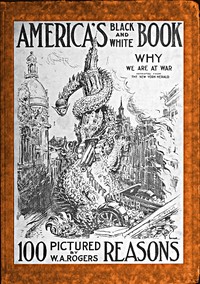
America's Black and White Book: One Hundred Pictured Reasons Why We Are At War
This isn't a novel with a plot in the usual sense. The 'story' here is America's emotional and political journey into the First World War. Published in 1917, right after the U.S. declared war on Germany, the book collects 100 of W.A. Rogers's editorial cartoons. Rogers was a famous political artist for the New York Herald, and his work was everywhere.
The Story
Page by page, you watch the argument for war unfold. Early cartoons frame Germany as a brutal invader, stomping on Belgium and threatening the world. You see powerful images meant to stir outrage and build support for the Allies. As the book goes on, the focus shifts to America's mobilization—the need for unity, the call to buy Liberty Bonds, and the spirit of sacrifice. The 'characters' are symbols: a determined Uncle Sam, a treacherous Germany, and a noble France. The narrative is driven by emotion, not events. It's the story of how a nation convinced itself to fight.
Why You Should Read It
This book is a gut punch. Reading it today is a wild experience. You're pulled into this intense, black-and-white world of pure conviction. Rogers's art is fantastic—clear, forceful, and loaded with meaning. But what's really compelling is seeing how propaganda works. These images were designed to make people feel, not just think. You get a direct line to the public mood of 1917, with all its simplicity, passion, and sometimes, blunt prejudice. It makes you wonder: what images are we seeing today that will define our era for future readers? It's a masterclass in visual persuasion.
Final Verdict
Perfect for anyone curious about WWI, the power of media, or American culture. If you love history, this is a primary source that feels alive. Graphic novel fans will appreciate the storytelling through sequential art. It's also a quick, visually engaging read—you can spend hours or just flip through and still get the impact. Just be ready: this is history without the hindsight. It doesn't come with modern commentary or apology. It's a loud, bold, and unfiltered voice from the past, and that's what makes it so fascinating.
This content is free to share and distribute. Distribute this work to help spread literacy.
Ava Johnson
1 year agoSolid story.
Noah Lopez
1 year agoJust what I was looking for.
Sandra Anderson
1 year agoSolid story.
Kevin White
1 year agoLoved it.

Barbara Rodriguez
1 year agoText is crisp, making it easy to focus.