
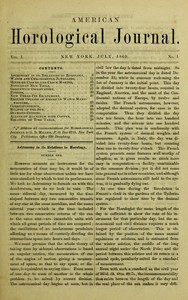
American Horological Journal, Vol. I, No. 1, July 1869: Devoted to Pratical…
Let's be clear from the start: this isn't a storybook. American Horological Journal, Vol. I, No. 1 is exactly what it says on the cover—the inaugural issue of a professional magazine for watchmakers, published in July 1869. There's no main character or plot twist in the traditional sense. Instead, the 'story' is the collective effort of a fledgling American industry finding its voice.
The Story
The journal opens with a kind of manifesto, a call to arms for American watchmakers to step out of Europe's shadow and share their knowledge. From there, it's a mix of technical articles, workshop tips, industry news, and even some dry humor. You'll read detailed instructions on tempering steel springs, explanations of new escapement designs, and reports on watchmaking schools. Advertisements for tools and parts are sprinkled throughout, painting a picture of the trade's ecosystem. The overarching narrative is one of creation and problem-solving, written by practitioners for practitioners.
Why You Should Read It
I loved this for the sheer, unfiltered access it provides. You're not reading a historian's summary; you're reading the raw, shop-floor conversation. The passion is palpable. These writers weren't just technicians; they were artists and engineers obsessed with perfection. Reading their precise, sometimes heated discussions about a hundredth of a millimeter reveals a world where craftsmanship was king. It completely reframes the humble pocket watch from a simple accessory to a marvel of human miniaturization and coordination. It made me appreciate the insane amount of thought in every tick.
Final Verdict
This is a niche read, but a fascinating one. It's perfect for history buffs who love primary sources, makers and tinkerers of all kinds, or anyone fascinated by the hidden mechanics of everyday things. If you enjoy shows like 'How It's Made' or podcasts about the history of technology, you'll find something special here. It's not a page-turner, but a slow, rewarding look into the minds that helped build modern precision. Just be ready for a lot of talk about mainsprings.
This work has been identified as being free of known copyright restrictions. It is available for public use and education.
Margaret Miller
1 year agoAmazing book.
Paul Ramirez
7 months agoI came across this while browsing and it manages to explain difficult concepts in plain English. This story will stay with me.
Steven Lopez
8 months agoFast paced, good book.
Donald Ramirez
6 months agoSurprisingly enough, it creates a vivid world that you simply do not want to leave. Worth every second.








Ashley Wright
5 months agoSimply put, the pacing is just right, keeping you engaged. A valuable addition to my collection.