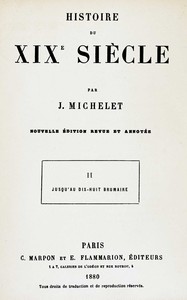
Histoire du XIXe siècle (volume 2/3) : II. Jusqu'au dix-huit Brumaire by Michelet
Jules Michelet's second volume picks up right after the Reign of Terror ends. The king is dead, the external enemies are defeated, but France is a total mess. The revolutionary government, now called the Directory, is in charge. Think of it as a committee trying to run a country that's broke, hungry, and deeply divided. They're not evil tyrants; they're mostly just overwhelmed bureaucrats trying to stop everything from falling apart.
The Story
This isn't a story with a single hero. It's the story of a system slowly failing. Michelet walks us through five years of political paralysis. The Directory struggles with royalist plots, angry radicals, and a crashing economy. Elections keep producing results they don't like, so they cancel them. It's a cycle of frustration. Meanwhile, the army, led by a brilliant and popular young general named Napoleon Bonaparte, becomes the only institution that actually works. The book builds, almost like a thriller, toward the event named in the subtitle: the Eighteenth of Brumaire. That's the date on the revolutionary calendar when Napoleon staged his bloodless coup, dissolved the Directory, and effectively ended the French Republic. Michelet shows us it wasn't a sudden explosion, but the final sigh of a government that had already lost the faith of its people.
Why You Should Read It
You should read this because Michelet makes history feel immediate. He's not a neutral observer; he's a passionate republican who is heartbroken watching the revolution fail. His writing crackles with energy and opinion. He'll describe a political debate with the tension of a courtroom drama, or paint a portrait of a corrupt politician with sharp, memorable detail. He makes you understand that history is made by tired people making bad choices for what seem like good reasons at the time. The theme that hit me hardest was the danger of exhaustion. The French people were just so tired—tired of chaos, tired of ideology, tired of scarcity. That collective fatigue made them willing to trade fragile liberty for the promise of stability and order, which Napoleon expertly offered.
Final Verdict
This book is perfect for anyone who loves political drama or wonders how democracies can stumble. It's not a dry military history; it's a character-driven study of a society in crisis. You'll get the most out of it if you have a basic idea of the Revolution's early years (Volume 1 covers that). It's for the reader who wants to go beyond the simple story of 'revolution then Napoleon' and understand the complicated, human years in between. Michelet is your fiercely intelligent, slightly biased, and utterly compelling guide through the wreckage of a dream.
This work has been identified as being free of known copyright restrictions. Thank you for supporting open literature.