
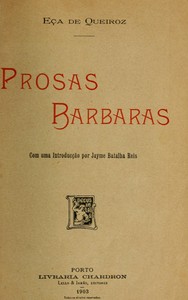
Prosas barbaras by Eça de Queirós
Most readers know Eça de Queirós as the sharp, witty author of classics like The Maias, a master at dissecting Portuguese society with a surgeon's precision. Prosas Bárbaras (Barbaric Proses) is something else entirely. This is young Eça, writing in the 1860s and 70s, before he fully embraced realism. The book is a collection of short, experimental pieces he published in magazines—think of them as literary mood boards or vivid, unfinished paintings.
The Story
There isn't one single story here. Instead, you get a series of glimpses into other worlds. In one piece, a man becomes obsessively, tragically in love with a perfect marble statue. In another, we're transported to fantastical, dreamlike cities that could never exist. Other texts are more like philosophical rants or poetic meditations, where characters argue about the nature of beauty, the emptiness of modern life, or the shadow of death. The 'plot' is the journey of Eça's own mind, trying on different styles—Gothic, Romantic, Symbolist—like costumes, searching for his own voice.
Why You Should Read It
Reading this is like getting a backstage pass to a genius's creative workshop. You see the bolts and seams. The prose is often lush and overheated, dripping with atmosphere in a way his later, cleaner novels are not. It's self-indulgent, sure, but thrillingly so. You can feel him testing the limits of language and imagery. For me, the most fascinating parts are the moments where you catch a flash of the future Eça—a sly observation, a sudden burst of irony—poking through the romantic fog. It makes you appreciate the disciplined artist he became, because you see all the wild energy he eventually learned to channel.
Final Verdict
This isn't the book to start with if you're new to Eça de Queirós (begin with The Maias or Cousin Basilio). But if you already love his work, Prosas Bárbaras is essential. It's for readers who are curious about how great writers are made, who enjoy poetic, atmospheric writing, and who don't mind a book that's more about vibe than a tight narrative. Perfect for fans of Edgar Allan Poe's gloom, the early, weird stories of other 19th-century giants, or anyone who loves seeing the raw, untamed draft before the final masterpiece.
This is a copyright-free edition. Use this text in your own projects freely.
James Perez
7 months agoI wanted to compare this perspective with traditional views, the way it handles controversial points with balance is quite professional. Well worth the time invested in reading it.
Margaret Martinez
3 months agoAfter a thorough walkthrough of the table of contents, the logic behind each conclusion is easy to follow and verify. I’ll definitely be revisiting some of these chapters again soon.
Barbara Smith
1 year agoI appreciate the objective tone and the evidence-based approach.
George Thompson
10 months agoLooking at the bibliography alone, the objective evaluation of the pros and cons is very refreshing. Top-tier content that deserves more recognition.
George Garcia
11 months agoThe balance between academic rigor and readability is perfect.