
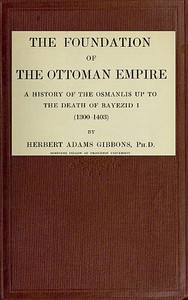
The Foundation of the Ottoman Empire; a history of the Osmanlis up to the death…
Most history books about the Ottomans start with the conquest of Constantinople in 1453. Gibbons does something much more interesting: he starts at the very beginning, when the name 'Ottoman' was just a whisper. His book covers the period from the late 13th century up to 1402, following the clan founded by Osman I.
The Story
Think of it as a historical underdog story. The book follows the Osmanli tribe as they emerge from the chaotic aftermath of the Seljuk Empire in Anatolia. They weren't the biggest or the strongest group around. Gibbons shows how they used a mix of military skill, smart alliances, and religious fervor to chip away at the weakened Byzantine Empire. He walks us through the reigns of the first sultans—Osman, Orhan, and Murad I—detailing how they expanded from a tiny principality into a serious regional power. The narrative builds toward the pivotal Battle of Ankara in 1402, a massive defeat that nearly ended the Ottoman story before it truly began.
Why You Should Read It
What grabbed me was the sheer human drama. Gibbons, writing in the early 1900s, has a point of view. He paints the early Ottomans not as faceless conquerors, but as ambitious, adaptable, and sometimes ruthless leaders who saw a power vacuum and seized it. You get a real sense of the precariousness of their rise. One bad decision or lost battle could have erased them from history. It makes their eventual success feel earned, and far more fascinating than if they were just destined for glory. It's a masterclass in how empires are really built: not by fate, but by a combination of luck, skill, and relentless drive.
Final Verdict
This is a classic for a reason. It's perfect for anyone curious about how great powers are born, especially readers who enjoy narrative history with clear characters and high stakes. While some of Gibbons' 1916 perspectives feel a bit dated to a modern reader, that's part of its charm—it's a snapshot of how people a century ago understood this empire's origins. If you're tired of history that starts at the climax, and you want to understand the gritty, foundational hustle, this book is an absolutely essential and gripping read.
This book is widely considered to be in the public domain. Thank you for supporting open literature.
James Smith
2 months agoI've gone through the entire material twice now, and it addresses the common misconceptions in a very professional manner. The price-to-value ratio here is simply unbeatable.
Robert Anderson
2 years agoFrom a researcher's perspective, the emphasis on ethics and sustainability within the topic is commendable. I'm genuinely impressed by the quality of this digital edition.
Ashley Thomas
6 months agoInitially, I was looking for a specific answer, but the case studies and practical examples provided add immense value. It cleared up a lot of the confusion I had previously.
Karen Hernandez
1 year agoSurprisingly enough, the storytelling feels authentic and emotionally grounded. This story will stay with me.




Kimberly Johnson
1 month agoA must-have for graduate-level students in this discipline.