
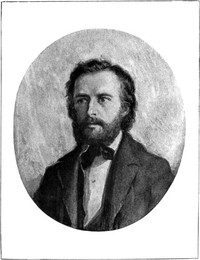
The Riddle of the Universe at the close of the nineteenth century by Ernst Haeckel
Let's be clear from the start: this isn't a novel. There's no plot in the traditional sense. The 'story' is the unfolding of one man's grand, unified theory of everything, written at a time when science was radically reshaping humanity's self-image.
The Story
Ernst Haeckel, a famous zoologist and fierce supporter of Darwin, structures his book like a philosophical investigation. He starts with the most basic questions about matter, energy, and the laws of nature. Then, step by step, he builds his case. He uses evolution to explain the origin of life and the dizzying diversity of species, including humans. He argues that the mind and soul are not magical things but products of our physical brains. He looks at society, ethics, and even religion, claiming they all need to be re-examined through a scientific lens. The climax of the 'story' is his conclusion: that a monistic worldview (where everything is one substance, governed by natural laws) solves the age-old riddle. There is no supernatural realm; the universe and everything in it is a single, magnificent, natural process.
Why You Should Read It
You read this book for the sheer intellectual audacity. Haeckel isn't timid. He takes science's new power and runs with it as far as it can go, dismissing ideas that don't fit his materialistic framework. It's fascinating to see which of his 1899 predictions feel prescient and which feel hopelessly dated. His passion is contagious, even when you disagree. More than anything, the book is a time capsule. It captures the thrilling, sometimes terrifying, optimism of an era that believed science was on the verge of explaining it all. You get to witness the birth pangs of modern secular thought.
Final Verdict
This book is perfect for curious readers who love history of science and big ideas. It's for anyone who enjoyed books like 'Sapiens' and wants to see a raw, earlier version of that kind of sweeping narrative. Be warned: some of Haeckel's social views are jarring and offensive by today's standards, and his science is obviously outdated. Don't read it for factual answers. Read it as a dramatic, landmark document. It shows a pivotal moment when one man tried to replace ancient mysteries with a new, science-based story of everything. For that reason alone, it's a compelling and unforgettable read.
The copyright for this book has expired, making it public property. You are welcome to share this with anyone.
Linda White
5 months agoI took detailed notes while reading through the chapters and the nuanced approach to the central theme was better than I expected. This adds significant depth to my understanding of the field.
Susan Walker
1 year agoI had low expectations initially, however the flow of the text seems very fluid. A true masterpiece.
Mary Miller
9 months agoHaving read this twice, the narrative structure is incredibly compelling. A true masterpiece.
Christopher Smith
1 year agoFrom the very first page, the flow of the text seems very fluid. I will read more from this author.
Paul Brown
2 months agoThe peer-reviewed feel of this content gives me great confidence.