
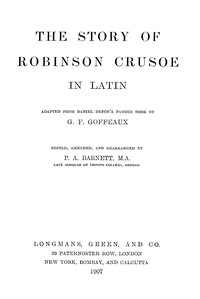
The story of Robinson Crusoe in Latin : Adapted from Daniel Defoe's famous…
We all know the story, right? A headstrong young man named Robinson Crusoe ignores his father's advice, goes to sea, and ends up shipwrecked on a deserted island. He's the only survivor. For nearly three decades, his world is that beach, those trees, and the few supplies he salvages from the wreck. The plot is a masterclass in step-by-step survival. We watch him build a shelter, grow food, make pottery, and even tame goats. The real drama comes from his internal struggle—the crushing loneliness, the fear, and the slow, hard-won shift from despair to a determined, almost peaceful, existence. His life changes again when he discovers a single footprint in the sand, proof he is not alone. This leads to his famous relationship with Friday, a native man he rescues, and their eventual escape.
Why You Should Read It
Reading this in Latin isn't about showing off. It's about feeling the story differently. Defoe's original English is from the 1700s, which already feels distant. Putting it into Latin, a language over two millennia old, adds another layer of timelessness. Crusoe's basic struggles—finding food, building a home, confronting solitude—feel primal and elemental. The Latin prose, often direct and concrete, suits the practical nature of his tasks perfectly. It strips some of the 18th-century flourish away and leaves a surprisingly raw narrative of human endurance. You appreciate the simple, powerful verbs for 'build,' 'gather,' and 'fear' in a new way.
Final Verdict
This is a niche book, but a brilliant one for the right reader. It's perfect for Latin students who are tired of translating war speeches and myths and want a gripping, novel-length story to tackle. It's also for adventurous bibliophiles who love Robinson Crusoe and want to experience it from a completely fresh angle. You'll need some patience and probably a dictionary nearby, but the reward is a unique, almost meditative connection to one of literature's greatest survival tales. It's not the easiest read, but it might just be the most memorable version of Crusoe's story you'll ever encounter.
This content is free to share and distribute. You do not need permission to reproduce this work.
Paul Smith
1 year agoThe layout of the digital version made it easy to start immediately, the formatting on mobile devices is surprisingly crisp and clear. The price-to-value ratio here is simply unbeatable.
Patricia Jones
2 years agoThe clarity of the introduction set high expectations, and the cross-referencing of different chapters makes it a great study tool. It’s a comprehensive resource that doesn't feel bloated.







Mary Miller
5 months agoExactly what I was looking for, thanks!