About 753 minutes
The Seri Indians. (1898 N 17 / 1895-1896 (pages 1-344*)) — Background and Themes
Social Conditions
173,120 recorded words. 0 minutes difference from this book's estimate.
View Gutenberg source #49403
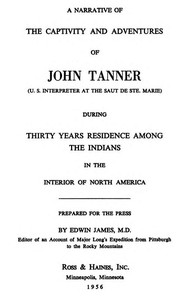
This digital edition of A Narrative of the Captivity and Adventures of John Tanner (U.S. Interpreter at the Saut de Ste. Marie) During Thirty Years Residence among the Indians in the Interior — Inside the Classic is described by source-level measurements including 173,050 words, 12 hr 33 min estimated reading time, and 23 detected text sections.
The text analysis averages about 25.7 words per sentence, while the detected sections provide another way to judge how the source is divided.
Project Gutenberg metadata also associates the work with “Indians of North America -- Languages -- Glossaries, vocabularies, etc.,” connecting these edition facts with the source record’s subject description.
Explore this collection
These alternatives are selected using recorded categories and estimated reading time.
About 753 minutes
Social Conditions
173,120 recorded words. 0 minutes difference from this book's estimate.
View Gutenberg source #49403About 773 minutes
Social Conditions
177,628 recorded words. 20 minutes difference from this book's estimate.
View Gutenberg source #30646About 732 minutes
Social Conditions
168,308 recorded words. 21 minutes difference from this book's estimate.
View Gutenberg source #52423Search stored excerpts and compare books → Choose by your preferences →
Choices use stored catalog measurements. Estimates vary with reading speed. A shared category is a catalog label, not a claim that two books have the same argument or literary quality.
Search reads excerpt text stored with this catalog and links to its associated Gutenberg record. The connection is stored in the site database; this tool does not recheck that every excerpt is word-for-word identical to that external record. Excerpt search does not cover every chapter and does not verify historical publication dates.
Catalog snapshot checked: 2026-09-26. Coverage: 93 public books, 93 available source excerpts.
Calculated from edition completeness, EPUB availability, text structure and catalogue metadata. Not a user rating.
Total of 100 points, scaled to a 2.5-5.0 range. Editions with an empty description or a missing EPUB file are not scored.
Public-domain source text
The source text is kept in the dedicated reader, separate from this catalogue record and its commentary.
John Tanner's narrative begins not with his capture but with his later life as an interpreter at Sault Ste. Marie, framing the entire account as a retrospective explanation of how a white boy became an Ojibwa man. The editor, Edwin James, notes in his introduction that Tanner had lived only nine years among whites before his capture, then spent thirty years with Indians, eventually forgetting his English name and language. This framing immediately sets up the central tension: Tanner's identity is neither fully white nor fully Indian, and the narrative will trace how that ambiguity shaped every aspect of his life.
The introduction by Edwin James establishes the tragic arc before Tanner's own voice is heard. James describes Tanner as a man who had 'no country, no people, no one who understood him,' and notes that his attempt to rejoin white society after thirty years proved impossible. This editorial framing is crucial: it tells the reader that the narrative to follow is not a simple adventure story but a document of cultural dislocation. The opening also reveals that Tanner's story continued long after the book was printed in 1830—he spent sixteen more years trying to find a place in white society, a fact that colors every episode of the captivity narrative itself.
In the middle of the narrative, Tanner describes his work as a hunter for the Hudson's Bay Company, killing about one hundred buffalo in four months. The details are concrete: he delivered forty entire and fat buffalo to the company, for which he was paid three hundred and ten dollars. But the excerpts also reveal social friction. Tanner notes that the Scots labourers he worked with 'were much more rough and brutal in their manners than any people I had before seen,' and he contrasts the abusive clerk M'Donald with the respectful M'Kenzie, who stayed to learn the Ojibbeway language. These observations show Tanner navigating between two worlds, judging both Indians and whites by his own standards.
A later passage describes the medicine man Ais-kaw-ba-wis, whose influence over the community remains undiminished even after a woman accuses him of sexual misconduct. Tanner's reaction is telling: he finds the man's drunken, naked appearance 'ludicrous in the extreme' and does not refrain from 'irreverent merriment.' Yet he also recognizes that Ais-kaw-ba-wis's ill will forces him to leave the settlement. This episode illustrates the complex power dynamics within Ojibwa society, where spiritual authority could override moral transgressions, and where Tanner, despite his long residence, remained vulnerable to the whims of influential individuals.
The narrative is presented as Tanner's own story, but it was written down and edited by Edwin James, a doctor who had previously edited an account of Major Long's expedition. This collaborative authorship raises questions about voice and authenticity. The excerpts show a mixture of detailed observation and personal reflection, but the reader cannot know how much James shaped the prose. The narrative also includes glossaries of Indian languages, reflecting James's scientific interests. Readers should approach the text as a hybrid document—part autobiography, part ethnographic record—and consider how the editorial hand may have influenced the portrayal of Tanner's experiences.
John Tanner's narrative resists easy categorization. It is at once a captivity story, a memoir of cultural adaptation, and a record of Ojibwa and Ottawa life in the early nineteenth century. The excerpts reveal a man who observed both Indian and white societies with a critical eye, but who ultimately belonged fully to neither. Readers will find the most value by attending to the specific details of daily life, trade, and conflict, and by remaining aware of the editorial frame that shapes Tanner's story.
I remember John Tanner’s slow fading between two worlds, a man never quite at home anywhere. That ache for a fixed place lingers. Turning to Legends of Loudoun An account of the history and homes of a border county of Virginia's Northern Neck — Key Ideas to Explore, I find a quieter echo: how even a settled land holds its own restless borders, its homes whispering of belonging and leave-taking alike.
Capture what you thought, learned, and would like to remember.