About 225 minutes
Prisoners of Poverty Abroad — Context and Discussion
Social Conditions
51,714 recorded words. 1 minutes difference from this book's estimate.
View Gutenberg source #28245
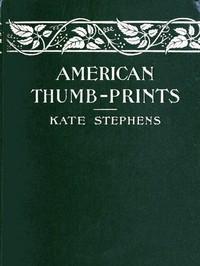
Before opening American Thumb-prints: Mettle of Our Men and Women — Story, Setting & Ideas, the edition data offers a quick orientation: 51,470 words, 3 hr 44 min estimated reading time, and 6 detected text sections.
The text analysis averages about 24.8 words per sentence, while the detected sections provide another way to judge how the source is divided.
Project Gutenberg metadata also associates the work with “Women -- Social conditions,” connecting these edition facts with the source record’s subject description.
Explore this collection
These alternatives are selected using recorded categories and estimated reading time.
About 225 minutes
Social Conditions
51,714 recorded words. 1 minutes difference from this book's estimate.
View Gutenberg source #28245About 228 minutes
Social Conditions
52,306 recorded words. 4 minutes difference from this book's estimate.
View Gutenberg source #14825About 235 minutes
Social Conditions
53,991 recorded words. 11 minutes difference from this book's estimate.
View Gutenberg source #44396Search stored excerpts and compare books → Choose by your preferences →
Choices use stored catalog measurements. Estimates vary with reading speed. A shared category is a catalog label, not a claim that two books have the same argument or literary quality.
Search reads excerpt text stored with this catalog and links to its associated Gutenberg record. The connection is stored in the site database; this tool does not recheck that every excerpt is word-for-word identical to that external record. Excerpt search does not cover every chapter and does not verify historical publication dates.
Catalog snapshot checked: 2026-09-26. Coverage: 93 public books, 93 available source excerpts.
Calculated from edition completeness, EPUB availability, text structure and catalogue metadata. Not a user rating.
Total of 100 points, scaled to a 2.5-5.0 range. Editions with an empty description or a missing EPUB file are not scored.
Public-domain source text
The source text is kept in the dedicated reader, separate from this catalogue record and its commentary.
Kate Stephens opens American Thumb-prints with a study of Kansas, a state she describes as prone to 'experimental meliorism' and 'aberrations of the crowd.' Rather than dismissing these tendencies, she argues that Kansans are 'distinctly simple in mental habit and independent in judgment,' a claim she supports by tracing their political movements—Grangerism, Greenbackism, Prohibitionism, Populism—back to a Puritan inheritance. The essay 'Puritans of the West' thus sets the book's pattern: Stephens uses local detail to challenge national stereotypes, blending historical anecdote with sharp observation.
In 'The University of Hesperus,' Stephens turns her attention to the University of Kansas, where she taught. She sketches the institution's founding and early struggles, noting how its development mirrored the state's ambitions. The essay is less a history than a character study: she describes the 'mettle' of faculty and students, their 'zeal' and 'executive' energy, and the tension between frontier pragmatism and academic ideals. Stephens does not shy from criticism, pointing to 'phlegmatic' resistance to change and the 'doctrinaire' tendencies she elsewhere attributes to Kansas politics. The university, for her, is a laboratory of American character—a place where 'experimental meliorism' meets the hard work of building a civilization.
In 'Up-to-Date Misogyny,' Stephens confronts contemporary attacks on women with a blend of erudition and irony. She cites a Latin professor who dismisses women's voices as 'neurotic caterwauling,' then coolly notes that 'specialists in nervous difficulties have not yet determined there is marked variation between neurotic caterwauling of hysterical women and neurotic caterwauling of hysterical men.' She draws on historical examples—Cicero's 'shrieks,' Byron's 'wails,' Marie Bashkirtseff's 'megalomaniac whine'—to argue that misogyny is not a rational critique but a 'reverse side' of idealization. Her method is comparative: she refuses to let men's emotional excesses escape scrutiny. The essay is a model of measured polemic, using logic and literary reference to dismantle double standards.
The final essay, 'Plagiarizing Humors of Benjamin Franklin,' examines Franklin's use of borrowed material. Stephens argues that Franklin's genius lay not in originality but in his ability to adapt and repurpose—a 'plagiarizing humor' that was itself a form of invention. She traces his sources in Poor Richard's almanac and other writings, showing how he transformed proverbs and anecdotes into distinctly American wisdom. The essay is less a defense of plagiarism than a meditation on creativity in a new nation: Franklin, like the Kansas settlers, built something new from available materials. Stephens's tone is admiring but precise, avoiding hagiography in favor of analysis.
Stephens's essays reward readers who attend to her method: she moves from local instance to general principle, using specific details—a political movement, a university dispute, a misogynist remark, a Franklin aphorism—to illuminate broader patterns of American character. Her voice is learned but direct, skeptical of cant whether from reformers or reactionaries. The book is best read as a series of interconnected arguments rather than a unified thesis; each essay stands alone, but together they form a portrait of a nation in the making, seen through the eyes of a sharp-eyed participant.
I keep thinking about how American Thumb-prints talks about the quiet stubbornness in all of us, that Puritan thread we can’t quite shake. It reminded me of an old afternoon spent with The crowd — Background and Themes, where the same loneliness shows up, only sideways, in how we lose ourselves among others. Funny how those two books sit together like old friends. We never quite escape either, do we?
Use these questions to collect your thoughts before moving on.