"Broke," The Man Without the Dime — Edition Insights

(0 User reviews)   2822
In Category - Social Conditions
Brown, Edwin A., 1857-1946 Project Gutenberg 2014 Not confirmed
Tramps; Unemployed -- United States Readers of public-domain and historical texts
Project Gutenberg digital edition en

Edition facts

Words 92,551
Reading time 403 min
Text sections 10

For "Broke," The Man Without the Dime — Edition Insights, the stored edition analysis reports 92,551 words, 6 hr 43 min estimated reading time, and 10 detected text sections.

The text analysis averages about 20.8 words per sentence, while the detected sections provide another way to judge how the source is divided.

Project Gutenberg metadata also associates the work with “Tramps,” connecting these edition facts with the source record’s subject description.

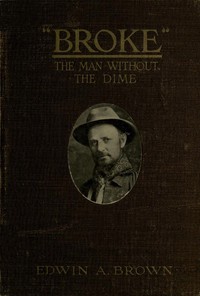
Edwin A. Brown, disguised as a penniless tramp, travels to 30+ U.S. cities documenting the lives of homeless workers. His firsthand accounts reveal municipal neglect, police brutality, and the stark contrast between wealth and destitution in early 20th-century America.
Share
Editorial Edition Score 4.9/5

Calculated from edition completeness, EPUB availability, text structure and catalogue metadata. Not a user rating.

How this score is calculated
  • Description quality20 pts
  • Title & short description10 pts
  • Source metadata20 pts
  • Text length15 pts
  • Chapters / structure15 pts
  • EPUB file integrity20 pts

Total of 100 points, scaled to a 2.5-5.0 range. Editions with an empty description or a missing EPUB file are not scored.

Edition quality

Read the Text

ere of iron and painted white, and placed one above the other, that is, "double-deck," and furnished with woven wire springs. The mattresses and pillows were of hair, and exceedingly comfortable. The linen was snowy white.

I had been in bed but a short time when an old man about seventy years of age took the bed next to mine. As he lay down in that public place I heard him breathe a little prayer, ever so softly and almost inaudibly, but I heard it--"Oh, God, I thank Thee!" And I said to myself, "That prayer ought to build a Municipal Emergency Home in every city of our land." It came to me then what a great and wonderful social clearing-house it was or could be.

I did not sleep, I did not want to sleep, but lay there taking mental notes of the soul's activity. The room was quiet and restful except for the restless man who silently walked the floor. As he came over near me I said to him, "Man, what is the matter?"

He came close to my bed and said, with a hot, flushed face, "I was not considered a subject for the isolation ward, but I am on the verge of delirium tremens. Feel my pulse, isn't it jumping to beat the devil?"

I felt his pulse; it was jumping like a trip-hammer. But in the way of assurance I answered, "No, your pulse is normal."

"Have we been up here four hours? They gave me some medicine downstairs to take every four hours, and if I was restless, I was to send down for it and take a dose."

"No, I think we have been up here about two hours. You might send down for it, and if it is a good thing to take a full dose every four hours, you might take a half-dose in two hours."

He hesitated for a moment, then agreed. I advised him to cut out the drink, and he went to the attendant for his medicine, received it, and slept like a babe until dawn. There is an attendant in each dormitory all night long, and he must report to the office by telephone every hour, not being allowed to sleep one moment on duty.

A few days later, after my visit was made public, I received many letters at my hotel, and among them was one from this man. He thanked me for my bit of advice to cut out the drink, and said that he had braced up and had not drunk a drop since that night, and that he had determined to be a man and fill a man's place in the world. His resolution was not due to my advice at all. It was due to the influence of "God's House," to New York's Municipal Emergency Home, and had turned him back to his true inheritance.

At six o'clock in the morning we were called. Every man took the linen from his bed and put it in a pile where it was all gathered up and taken afterward to the laundries. Every day fresh and spotless linen is supplied.

We then went down and dressed and were given our breakfast--as fine a dish of oatmeal as I ever ate, and again most delicious hot coffee with milk and sugar, bread and butter. And again every man had abundance. I said to a boy who sat on my right, "How do you feel this morning?"

"I tell you I feel as if someone cared for me," he answered, "I feel like getting out and hustling harder than ever for a job to-day."

Edwin A. Brown’s “Broke,” The Man Without the Dime (1913) is a work of investigative undercover reporting that predates the more famous Down and Out in Paris and London by two decades. Brown, a middle-class author, disguised himself as a homeless man and traveled to over thirty American cities, recording the conditions faced by the unemployed and transient workers. The book’s dedication—to those who “fight with bare hands for existence”—sets a tone of moral urgency that runs through every chapter.

The excerpts show Brown’s method: he embeds himself in breadlines, municipal lodging houses, and street scenes, often capturing raw moments of human dignity amid degradation. His prose is direct, observational, and occasionally laced with biblical allusion, as when he contrasts the Bowery’s “sin, the shame, the disease” with the “golden rule of Christ” embodied by a stranger who covers a naked woman. This tension between institutional failure and individual compassion is the book’s central pattern.

The Observer Embedded in the Crowd

Brown’s narrative voice is that of a participant-observer who rarely editorializes at length, instead letting scenes speak for themselves. In one passage, he describes a half-frozen young outcast sleeping in a wagon-bed who is “beaten senseless by the police a few minutes after the picture was taken.” The photograph itself becomes evidence of violence, not just poverty. Brown’s choice to include such details—the police beating, the “tattered rag of a coat,” the “mute as ‘dumb driven cattle’” breadline—creates a cumulative effect of systemic cruelty.

He also records dialogue that reveals the psychology of the homeless. An elderly man he meets in Union Square speaks of “the prejudice against the man a little beyond middle life” and the “past that stood as a barrier.” Brown does not judge; he simply notes the man’s residual “spark of courage.” This restraint is a deliberate rhetorical strategy, allowing the reader to draw conclusions about a society that forces its citizens into such despair.

Cities as Moral Landscapes

Each chapter is organized by city, and Brown treats each urban center as a moral test case. In New York, he contrasts the wealth of Old Grace Church with the “five hundred men” waiting silently for bread at midnight. In Chicago, he examines a “Municipal Lodging House” where men sleep in brick ovens. The pattern is consistent: a city’s wealth is measured against its treatment of the homeless. Brown’s catalog of cities—from “Little Pittsburg of the West” to “Spotless Detroit”—suggests that no region is exempt from the failure to provide for its workers.

He also notes the hypocrisy of religious institutions. In San Antonio, whose “very name is music,” he finds the church complicit in “the city’s sin against society.” The book’s structure—a tour of American failures—implies that the problem is national, not local. Brown’s evidence is always concrete: a photograph, a count of men in line, a verbatim exchange. He rarely offers solutions, but his accumulation of data functions as an indictment.

The Body as Evidence

Brown’s writing is notable for its attention to physical detail: the “discolored suit, badly worn shoes and tattered hat” of the old man, the “prone upon her face” woman whose skirt has fallen, the “half-frozen” boy in the wagon. These descriptions are not sensationalist; they are forensic. The body becomes a text that records the violence of poverty. Brown also includes photographs, some of which are described in captions that extend the narrative—like the boy beaten after his picture was taken.

This focus on the physical extends to the environment: the “brick ovens” used as shelters, the “bread line” that forms hours before distribution, the “prison door” that is the only open door for a destitute woman. Brown’s method is to show, not tell, but his selection of details is always pointed. The reader is left to infer the systemic failures that produce such bodies and such spaces.

Readers approaching “Broke” should attend to the tension between Brown’s role as an outsider and his attempt to represent the insider’s experience. He is not a homeless man, but he borrows their perspective. The book’s power lies in its accumulation of specific, verifiable observations—the number of men in a breadline, the texture of a coat, the words of a stranger. Brown’s project is not to offer policy solutions but to make the reader see, as he saw, the human cost of economic inequality.

Some patrons never see it, but Broke, The Man Without the Dime and The Jew and American Ideals — Text and Context share a shelf-soul: both watch America promise plenty, then turn its back. One walks the rails in rags, the other walks the streets in question. I always shelve them side by side, two quiet witnesses to the same unfinished bargain.

There are no reviews for this eBook.

0
0 out of 5 (0 User reviews )

Add a Review

Your Rating *
There are no comments for this eBook.

Reader reflection

Record your reading impressions

A brief reflection can help important ideas stay with you longer.

Your progress 0 / 10
1

Where are you in your reading?

2

How much did you enjoy the reading experience?

3

Would you encourage someone else to read it?

4

Did the language feel accessible?

Related eBooks