About 245 minutes
Burial Mounds of the Northern Sections of the United States — A Reader’s Guide
Customs Everyday Life
56,192 recorded words. 10 minutes difference from this book's estimate.
View Gutenberg source #41557
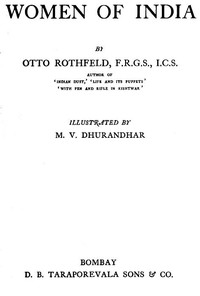
Women of India — Text and Context can be approached with a clearer sense of reading commitment from its source measurements: 58,536 words, 4 hr 15 min estimated reading time, and 8 detected text sections.
The text analysis averages about 25.5 words per sentence, while the detected sections provide another way to judge how the source is divided.
Project Gutenberg metadata also associates the work with “India -- Social life and customs,” connecting these edition facts with the source record’s subject description.
Explore this collection
These alternatives are selected using recorded categories and estimated reading time.
About 245 minutes
Customs Everyday Life
56,192 recorded words. 10 minutes difference from this book's estimate.
View Gutenberg source #41557About 295 minutes
Customs Everyday Life
67,687 recorded words. 40 minutes difference from this book's estimate.
View Gutenberg source #59402About 334 minutes
Customs Everyday Life
76,619 recorded words. 79 minutes difference from this book's estimate.
View Gutenberg source #9197Search stored excerpts and compare books → Choose by your preferences →
Choices use stored catalog measurements. Estimates vary with reading speed. A shared category is a catalog label, not a claim that two books have the same argument or literary quality.
Search reads excerpt text stored with this catalog and links to its associated Gutenberg record. The connection is stored in the site database; this tool does not recheck that every excerpt is word-for-word identical to that external record. Excerpt search does not cover every chapter and does not verify historical publication dates.
Catalog snapshot checked: 2026-09-26. Coverage: 93 public books, 93 available source excerpts.
Calculated from edition completeness, EPUB availability, text structure and catalogue metadata. Not a user rating.
Total of 100 points, scaled to a 2.5-5.0 range. Editions with an empty description or a missing EPUB file are not scored.
Public-domain source text
The source text is kept in the dedicated reader, separate from this catalogue record and its commentary.
Otto Rothfeld's Women of India (1915) opens not with a description of its subjects but with a scholarly invocation of ancient trade routes, Buddhist monasteries, and the legacy of Alexander's soldiers. This framing signals a work that situates Indian women within a broad historical and cultural panorama, rather than offering intimate portraiture. Illustrated by M.V. Dhurandhar, the book proceeds through chapters organized by social class and marital status, from aristocratic ladies to working women and dancing girls. The excerpts reveal a text dense with catalogues of communities—Pathare Prabhu, Borah, Bhatia, Khoja, Meman, Parsi—each described in terms of occupation, dress, and perceived social standing. Rothfeld, a British civil servant, writes as an external observer, blending ethnographic detail with judgments that reflect early twentieth-century colonial attitudes.
The book's structure is fundamentally taxonomic. Chapter headings such as "The Ladies of the Aristocracy," "The Middle Classes," and "The Working and Aboriginal Classes" reveal a systematic attempt to categorize women by social stratum. Within these chapters, Rothfeld enumerates sub-groups with precision: Pathan women, Borah ladies from Surat, Nair ladies, Jain nuns, Bhatia ladies, Khoja ladies, Meman ladies, and Parsis. Each receives a paragraph or more detailing their customs, dress, and economic roles. For instance, the Parsi woman is described as having "contrived no less to modify her own costume" in imitation of European fashion, retaining the sari but hemming it with imported borders and wearing "Louis Quinze shoes." This cataloguing impulse, while informative, often reduces individuals to representatives of their caste or community, a limitation Rothfeld does not acknowledge.
Rothfeld devotes an entire chapter to "Woman's Dress," and throughout the excerpts, clothing serves as a primary indicator of social position and cultural transformation. The Parsi woman's adoption of European-style jewelry and "silk stockings" is presented as a departure from tradition, with Rothfeld noting that she "despises the beautiful antique designs of the Indian goldsmith as 'old-fashioned.'" Similarly, the Meman lady walking is depicted in a specific garment that signals her community affiliation. The illustrations by Dhurandhar—listed as 48 plates—likely reinforce this visual emphasis. Rothfeld's observations on dress are among his most concrete, offering tangible details about fabric, ornament, and style. Yet his tone often carries implicit judgment, as when he describes Parsi women's demands for liberty as derived from "English novels" rather than genuine aspiration.
Rothfeld writes from a position of authority as a Fellow of the Royal Geographical Society and a member of the Indian Civil Service. His preface dedicates the book to a "constant well-wisher of Indian womanhood," signaling a reformist intent. However, the excerpts reveal a perspective that is both admiring and patronizing. He praises the "humane code" of Islamic law while noting that "devastation caused by Mongol invasions and ravages" must be repaired. He describes the Parsi community's rise through commerce and adaptability, attributing their success partly to "gratitude" from the British. The voices of Indian women themselves are absent; Rothfeld speaks about them, not for them. Readers should approach this text as a document of its time, valuable for what it reveals about colonial ethnography and the assumptions of its author, rather than as a direct account of women's experiences.
Rothfeld's Women of India rewards readers interested in early twentieth-century colonial ethnography, material culture, and the history of representation. The book's strength lies in its detailed descriptions of dress, community practices, and social stratification, all anchored by Dhurandhar's illustrations. Its limitations—the absence of women's own voices, the author's unexamined biases, and the taxonomic impulse that flattens individual lives—are equally instructive. For a fuller picture, pair this work with contemporary accounts by Indian writers or with modern scholarship on gender and colonialism.
Reading Rothfeld’s descriptions of women’s lives, I remembered my grandmother’s quiet stories, the way she’d measure a household by its kitchen sounds. That careful cataloguing of everyday detail felt familiar, like when I first opened Castes and Tribes of Southern India. Vol. 3 of 7 — Background and Themes. Both books hold lives at arm’s length, yet somehow, a warmth seeps through the old observations.
Use these questions to collect your thoughts before moving on.