About 269 minutes
The Maya Indians of Southern Yucatan and Northern British Honduras — Key Ideas to Explore
Social Conditions
61,741 recorded words. 5 minutes difference from this book's estimate.
View Gutenberg source #46973
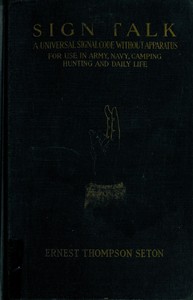
For Sign talk — Themes and Context, the stored edition analysis reports 60,618 words, 4 hr 24 min estimated reading time, and 26 detected text sections.
The text analysis averages about 11.1 words per sentence, while the detected sections provide another way to judge how the source is divided.
Project Gutenberg metadata also associates the work with “Sign language,” connecting these edition facts with the source record’s subject description.
Explore this collection
These alternatives are selected using recorded categories and estimated reading time.
About 269 minutes
Social Conditions
61,741 recorded words. 5 minutes difference from this book's estimate.
View Gutenberg source #46973About 273 minutes
Social Conditions
62,763 recorded words. 9 minutes difference from this book's estimate.
View Gutenberg source #15204About 254 minutes
Social Conditions
58,361 recorded words. 10 minutes difference from this book's estimate.
View Gutenberg source #445Search stored excerpts and compare books → Choose by your preferences →
Choices use stored catalog measurements. Estimates vary with reading speed. A shared category is a catalog label, not a claim that two books have the same argument or literary quality.
Search reads excerpt text stored with this catalog and links to its associated Gutenberg record. The connection is stored in the site database; this tool does not recheck that every excerpt is word-for-word identical to that external record. Excerpt search does not cover every chapter and does not verify historical publication dates.
Catalog snapshot checked: 2026-09-26. Coverage: 93 public books, 93 available source excerpts.
Calculated from edition completeness, EPUB availability, text structure and catalogue metadata. Not a user rating.
Total of 100 points, scaled to a 2.5-5.0 range. Editions with an empty description or a missing EPUB file are not scored.
Public-domain source text
The source text is kept in the dedicated reader, separate from this catalogue record and its commentary.
Ernest Thompson Seton's Sign Talk (1918) is a dictionary of 1,725 gesture signs, compiled from Cheyenne and other Plains Indian languages, with additions from Deaf communities, police, firemen, railroad workers, and schoolchildren. The book's structure is alphabetical by English headword, each entry giving a step-by-step description of the gesture, often with variant sources (e.g., "Scott" or "Sheeaka"), and French and German translations by Lillian Delger Powers. Seton's own 700 illustrations accompany many entries, showing hand positions and movements.
The core of Sign Talk is its alphabetical list of English words, each followed by a precise choreography of hand shapes, positions, and motions. For example, the entry for "Hear" instructs: "Move the right G hand (pointed forward) from behind the right ear, past the ear and forward." The descriptions consistently specify palm orientation (e.g., "backs down"), hand shape (e.g., "flat hands," "curved G"), and direction of movement (e.g., "sweep them down sidewise"). This systematic notation allows the reader to reconstruct each sign without relying solely on the illustrations.
Several hand shapes recur throughout the dictionary. The "G hand" (index finger extended, thumb up) appears in signs for "Heaven," "Here," and "Hear." The "flat hand" (fingers together, palm flat) is used for "Heavens," "Heavy," and "Hide (to conceal)." The "A fist" (thumb closed over fingers) appears in "Hill." Body positions are also standardized: signs are made "in front of body," "opposite neck," or "over heart." These repeated elements create a consistent grammar of gesture, making the code learnable as a system.
Seton frequently cites multiple sources for a single sign, indicating regional or tribal variation. For "Help," he gives a sign "borrowed from the Deaf" via Sheeaka, then adds "Or, sign Work and With" from Seger. The entry for "History" includes two variants: one using a sketching motion on the palm, another combining "Long," "Past," and "Tell me." These alternatives show that the code was not monolithic; Seton treated it as a living, composite language, documenting choices rather than prescribing a single correct form.
The 700 author-drawn illustrations are not decorative but integral to the dictionary's structure. Each drawing typically shows a pair of hands in the final position of a sign, with arrows or dotted lines indicating movement. The entry for "Herd of Animals" describes two distinct motions—first holding out the left hand, then drawing the right back in an arc—and the illustration would clarify the spatial relationship between the hands. Seton's background as a naturalist and illustrator (he wrote and illustrated Wild Animals I Have Known) is evident in the clarity and economy of these diagrams.
Readers should approach Sign Talk as a practical manual: try performing each gesture as you read, using the descriptions and illustrations together. The French and German equivalents at the end of each entry hint at Seton's ambition for a universal code, but the book remains firmly rooted in the Plains Indian traditions he observed firsthand. The preface notes that the manuscript sat for nine years before publication, and the work shows both the enthusiasm of a lifelong student and the limitations of a single compiler's perspective.
Flipping through Seton’s patient line drawings of hand signs, I kept thinking how every gesture once meant something lived, not just recorded. That same ache—the weight of a world trying to speak its truth—echoes in the quieter pages of Socialism and the Social Movement in the 19th Century — Reading Companion. Both feel like letters from another time, still warm.
Create a short personal record of your experience with this book.