About 71 minutes
The German Element in Brazil Colonies and Dialect — Themes and Context
Social Conditions
16,209 recorded words. 0 minutes difference from this book's estimate.
View Gutenberg source #17361
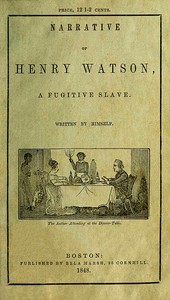
This digital edition of Narrative of Henry Watson, a fugitive slave — Themes and Context is described by source-level measurements including 16,222 words, 1 hr 11 min estimated reading time, and 3 detected text sections.
The text analysis averages about 25.4 words per sentence, while the detected sections provide another way to judge how the source is divided.
Project Gutenberg metadata also associates the work with “Slavery -- Mississippi,” connecting these edition facts with the source record’s subject description.
Explore this collection
These alternatives are selected using recorded categories and estimated reading time.
About 71 minutes
Social Conditions
16,209 recorded words. 0 minutes difference from this book's estimate.
View Gutenberg source #17361About 76 minutes
Social Conditions
17,447 recorded words. 5 minutes difference from this book's estimate.
View Gutenberg source #69934About 63 minutes
Social Conditions
14,282 recorded words. 8 minutes difference from this book's estimate.
View Gutenberg source #70167Search stored excerpts and compare books → Choose by your preferences →
Choices use stored catalog measurements. Estimates vary with reading speed. A shared category is a catalog label, not a claim that two books have the same argument or literary quality.
Search reads excerpt text stored with this catalog and links to its associated Gutenberg record. The connection is stored in the site database; this tool does not recheck that every excerpt is word-for-word identical to that external record. Excerpt search does not cover every chapter and does not verify historical publication dates.
Catalog snapshot checked: 2026-09-26. Coverage: 93 public books, 93 available source excerpts.
Calculated from edition completeness, EPUB availability, text structure and catalogue metadata. Not a user rating.
Total of 100 points, scaled to a 2.5-5.0 range. Editions with an empty description or a missing EPUB file are not scored.
Public-domain source text
The source text is kept in the dedicated reader, separate from this catalogue record and its commentary.
Henry Watson opens his 1848 narrative with a stark admission: he has no certain birth year, only a recollection of being born near Fredericksburg, Virginia, around 1813. The first pages establish a pattern of withheld knowledge—slaves are denied surnames, ages, and even the fate of their own mothers. Watson recalls being taken from his mother, Letty, while she worked as a cook at the great house; he awoke to find himself in the main house, and she was never seen again. This early rupture sets the tone for a narrative that moves from personal loss to a broader indictment of the system that produced it.
Watson’s prose is direct and unadorned, but it carries deliberate rhetorical choices. He notes that slaves keep track of children’s ages by planting seasons, yet even that knowledge was denied him. The phrase “as near as I can now recollect” recurs, signaling both the fragility of memory and the system’s erasure of personal history. When he asks for his mother, no one speaks; the silence is as telling as the words. Watson does not embellish the scene—he reports the facts, letting the reader feel the void.
Later, he describes how repeated exposure to suffering made his heart “begin to grow less feeling.” This is not a confession of callousness but a survival mechanism. The narrative voice shifts from the bewildered child to the hardened observer, then to the man who suppresses his hope until it grows stronger. These tonal changes mirror the psychological adaptation required to endure slavery.
Watson devotes a sustained passage to the religious instruction given to slaves. He quotes a sermon that tells the enslaved to bear punishment patiently, promising heavenly reward. His response is blunt: “Is it not an unpardonable sin for man thus to defile the holy sanctuary?” He refrains from extended commentary, stating that “the diabolical facts show fairly enough of themselves.” This restraint is characteristic—Watson often lets the quoted words of slaveholders stand as their own condemnation.
He also reveals the performative cheerfulness required of slaves. Any mood other than laughter and singing is taken as a sign of “the devil in them,” leading to whipping or sale. Watson describes how he learned to appear cheerful the more he reflected on his situation. The mask becomes a tool of resistance, a conscious strategy to avoid suspicion while planning escape.
The narrative traces Watson’s movement from Virginia to Mississippi, a shift that intensifies the difficulty of escape. He notes that Mississippi’s geography and the use of trained hounds made flight nearly impossible. Yet his hope, he insists, was only “suppressed,” not extinguished. The language of suppression and growth suggests an internal pressure that builds over time.
Watson also observes the careful surveillance of slaves by white visitors at hotels. He sought information about northern states but found that white travelers were “very careful what they say in the presence of the slaves.” This detail underscores the information blockade that enslaved people faced. The arrival of a sympathetic northern gentleman marks a turning point, but the excerpt ends before the outcome is revealed, leaving the reader in the same state of suspense Watson must have felt.
Watson’s narrative is as much about what is withheld as what is told—the mother who disappears, the age that cannot be fixed, the escape plan that remains unspoken until the final pages. Readers should attend to the gaps and silences, for they are as deliberate as the words. The narrative’s power lies in its refusal to sentimentalize; Watson trusts the facts to speak, and they do.
I have held Henry Watson’s narrative close for years, feeling that quiet ache of a child severed from his mother, and the slow burn of his fury at pious lies. It reminds me, somehow, of that other volume, Prisoners of Poverty Abroad — Context and Discussion, where chains wear different faces yet bind the spirit just the same. Both whisper of confinement wearing a righteous mask.
A brief reflection can help important ideas stay with you longer.