About 71 minutes
The German Element in Brazil Colonies and Dialect — Themes and Context
Social Conditions
16,209 recorded words. 8 minutes difference from this book's estimate.
View Gutenberg source #17361
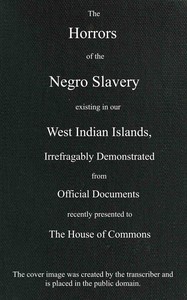
The horrors of the Negro slavery existing in our West Indian islands — Reading Companion can be approached with a clearer sense of reading commitment from its source measurements: 14,282 words, 1 hr 3 min estimated reading time, and 5 detected text sections.
The text analysis averages about 29.0 words per sentence, while the detected sections provide another way to judge how the source is divided.
Project Gutenberg metadata also associates the work with “Slavery -- Law and legislation -- Great Britain,” connecting these edition facts with the source record’s subject description.
Explore this collection
These alternatives are selected using recorded categories and estimated reading time.
About 71 minutes
Social Conditions
16,209 recorded words. 8 minutes difference from this book's estimate.
View Gutenberg source #17361About 71 minutes
Social Conditions
16,222 recorded words. 8 minutes difference from this book's estimate.
View Gutenberg source #69372About 76 minutes
Social Conditions
17,447 recorded words. 13 minutes difference from this book's estimate.
View Gutenberg source #69934Search stored excerpts and compare books → Choose by your preferences →
Choices use stored catalog measurements. Estimates vary with reading speed. A shared category is a catalog label, not a claim that two books have the same argument or literary quality.
Search reads excerpt text stored with this catalog and links to its associated Gutenberg record. The connection is stored in the site database; this tool does not recheck that every excerpt is word-for-word identical to that external record. Excerpt search does not cover every chapter and does not verify historical publication dates.
Catalog snapshot checked: 2026-09-26. Coverage: 93 public books, 93 available source excerpts.
Calculated from edition completeness, EPUB availability, text structure and catalogue metadata. Not a user rating.
Total of 100 points, scaled to a 2.5-5.0 range. Editions with an empty description or a missing EPUB file are not scored.
Public-domain source text
The source text is kept in the dedicated reader, separate from this catalogue record and its commentary.
The pamphlet opens by citing a letter from Lord Seaforth, Governor of Barbadoes, to Lord Hobart, dated 18 March 1802, in which Seaforth notes that the Assembly took offence at his recommendation to make the murder of a slave a felony. The fine for killing a slave was then only fifteen pounds currency, or eleven pounds four shillings sterling. This official document, the author argues, provides a stark measure of the value placed on enslaved lives in the oldest and most civilized of the British slave colonies.
The author uses this evidence to assert that the legal framework itself reveals the systemic brutality of slavery, without needing to rely on disputable analogies. The pamphlet then proceeds to examine further official papers presented to the House of Commons in 1805, which graphically describe the practice of slavery.
The author repeatedly insists that the evidence presented is beyond dispute, using terms like "irrefragably demonstrated" and "unquestionable authority." This rhetorical strategy aims to preempt counterarguments by framing the pamphlet as a presentation of facts rather than opinion. The opening paragraph sets this tone by stating that the official documents "supersede the necessity of reasoning" and silence even the most determined defender of West Indian practices.
However, the pamphlet is not merely a recitation of documents; it is a carefully constructed argument. The author selects and arranges the evidence to build a case against the slave trade and slavery itself. The voice is that of a moral prosecutor, addressing a British audience presumed to share European sensibilities that find the low legal value of a slave's life revolting.
A significant portion of the pamphlet engages with the economic arguments of pro-slavery advocates, whom the author calls "the reporters." The author accuses them of ignoring the competition from Trinidad and Dutch Guiana, which were cultivated by enslaved labour, while fixating on the East Indies. The author suggests that the reporters' real motive is a "sympathy with the owners of Slaves" that overrides even self-interest.
The author points out that the reporters opposed the regulation of the Middle Passage but later admitted those regulations benefited their interests. Similarly, they opposed abolition fourteen years earlier, which would have saved them from the ruinous competition of Dutch Guiana. The author uses this inconsistency to undermine the reporters' credibility, arguing that they are engaged in "gambling speculations" and do not know their own interests.
The author directly challenges the reporters' claim that the slave trade is sanctioned by Acts of Parliament and therefore a right. The author argues that no act of Parliament can convey the right to establish "such a frightful system of oppression" as the pamphlet has proved to exist. The author questions what act binds Parliament to uphold a system "outrageously opposed to every principle of British policy and of British law."
Furthermore, the author notes the irony that the reporters fear discussing abolition in Parliament, yet the debates are published in Jamaican official newspapers, and even the Report itself was inserted in the Royal Gazette of Jamaica. This observation undercuts the reporters' argument that public discussion would incite danger. The author concludes that the claim of right attaches to Britain, not Africa, which was no party to any contract.
Readers should attend to how the pamphlet weaves together official documents, logical rebuttals, and moral indignation. The author's voice shifts between presenting evidence and directly addressing the arguments of opponents, creating a dynamic that is both informative and persuasive. The pamphlet is a product of its time, reflecting the rhetorical strategies of the abolitionist movement in early 19th-century Britain.
Reading that old pamphlet, I kept thinking how carefully people once built arguments to justify cruelty, wrapping it in ledgers and law. It stayed with me, that weight. Something in The Social Direction of Evolution: An Outline of the Science of Eugenics — A Closer Reading felt familiar, that same quiet, confident tone deciding who gets to count as human. I just sat with that thought for a while.
Use these questions to collect your thoughts before moving on.