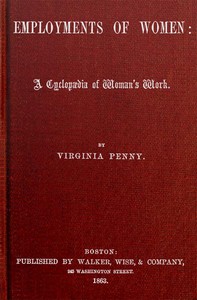
The Employments of Women: A Cyclopædia of Woman's Work — A Closer Reading
Edition facts
This digital edition of The Employments of Women: A Cyclopædia of Woman's Work — A Closer Reading is described by source-level measurements including 247,439 words, 17 hr 56 min estimated reading time, and 29 detected text sections.
The text analysis averages about 15.0 words per sentence, while the detected sections provide another way to judge how the source is divided.
Project Gutenberg metadata also associates the work with “Women -- Employment,” connecting these edition facts with the source record’s subject description.
Calculated from edition completeness, EPUB availability, text structure and catalogue metadata. Not a user rating.
How this score is calculated
- Description quality20 pts
- Title & short description10 pts
- Source metadata20 pts
- Text length15 pts
- Chapters / structure15 pts
- EPUB file integrity20 pts
Total of 100 points, scaled to a 2.5-5.0 range. Editions with an empty description or a missing EPUB file are not scored.
Read the Text
as were employed as computers on the Coast Survey at Washington in 1854, with salaries each of $480, with perquisites making it $600. A man to do the same work would probably receive twice as much." "Mrs. Miller, at one time, was engaged in making observations of the weather--the thermometer, barometer, direction of winds, quantity of rain, &c., in which she was assisted by another person appointed by a society of which both sexes were members." Computations of this kind could be made at home. Mr. Blodgett, who had charge of the Smithsonian Institute in 1854, wrote: "The discussion of observations in physical science, meteorological observations particularly, has never been undertaken in a general manner until attempted in this department of the Smithsonian Institute, and I have found that accuracy and despatch require well-trained minds of great endurance. Only the best minds can successfully undertake scientific calculations and computations; and these must possess a sort of half masculine strength and endurance." Yet we would not offer this as a discouragement. If it has been done, it can be done again. "During Mr. Fillmore's administration, two women wrote for the Treasury Department at Washington, at salaries of twelve and fifteen hundred a year." Several ladies are employed in different parts of the United States for copying by registers of deeds; but the majority are relatives of the registers. In some towns of the East, however, other ladies than relatives are employed, who receive $1 per day for their services. Miss Olive Rose has performed the duties of the register of deeds, at Thomaston, Maine. She writes: "I was officially notified of the election, required to give bonds, &c. I am unable to state the exact amount of salary, as it is regulated by whatever business is done in the office. Perhaps it may average between $300 and $400 yearly." The Duchess of Leuchtenberg was elected to preside over the Imperial Academy of Science, in Russia, a few years ago. An acquaintance told me that in the warehouses at the London docks, silks, shawls, and such goods are exposed for sale, and many ladies go down in their carriages and purchase. If any female is suspected of concealing on her person goods that she has appropriated in the warehouse, the watchmen who guard the place remark they would like to detain her for a few minutes, and convey her to a room, where a woman is in attendance to search her. The present collector of customs at Philadelphia writes: "The only instance of employment of women in connection with the custom house here has been, while Liverpool steamers were coming to this port, some years ago, when one or two were employed to search female emigrants, to prevent smuggling on their persons. The employment was only for a day or two at a time, and is now discontinued." Some time ago it was feared that large quantities of precious stones and laces were concealed on the persons of some women, and so smuggled into New York. Consequently "two American female searchers were inaugurated in the revenue service as aids. They each receive $500 per annum, and are paid by the month. Men receive $1,095 (or $3 per day) for similar services. The qualifications needed are intelligence, tact, and integrity. They spend but one or two hours on the arrival of each steamer or passenger received from abroad." I think, in European countries, female police, who examine the persons and passports of women, receive the same salaries as men.
Virginia Penny opens her 1863 cyclopedia with a blunt rejection of abstract advice: “good advice is not sufficient” when women need actual livelihoods. The preface situates the work in the Civil War context, noting that “a million of men are on the battle field” and thousands of women have lost their only support. Penny aims to redirect women from overcrowded markets into new avenues of labor, a goal she pursues through a systematic survey of trades.
A Practical Response to Crisis
Penny’s preface establishes a tone of urgent practicality. She dismisses existing books on “The Sphere of Woman” as irrelevant to women who lack the “comforts of life.” Instead, she proposes to open “avenues where they are wanted.” The language is direct and unadorned, focused on economic necessity rather than moral argument. Penny acknowledges the difficulty of measuring woman’s condition: “No mathematical nicety can be brought to bear upon the subject.” This admission of uncertainty contrasts with the detailed wage tables and employer letters that fill the subsequent entries.
Wages, Skill, and Gender in the Watch Trade
The entry on watchmaking illustrates Penny’s method: she reproduces correspondence from manufacturers, preserving their voices. A Boston chronometer maker reports paying women $4 to $6 per week, but notes that “men earn about double the wages of women” because they do “more difficult work” and are “more ingenious, more thoughtful and contriving.” The same writer adds that women “are very apt to marry just as they become skilful enough to be reliable.” A second manufacturer at the American Watch Company in Waltham states bluntly that “we employ female labor, where we can, as being cheaper.” These quotations expose the structural barriers women faced: lower pay for comparable work, assumptions about mechanical aptitude, and the expectation that marriage would end their careers.
Cataloging the Possible
Penny’s cyclopedia is organized as a reference work, with entries for each trade listing required skills, wages, and working conditions. The watchmaking section specifies that “delicacy of touch, patience, and great carefulness” are needed, and that learning takes “a few months perhaps.” She includes details about factory size, hours (ten per day), and the proportion of women employed (seventy-five out of two hundred hands at Waltham). The entry on watch case and jewelry polishing notes that “a good polisher can earn $1 a day,” but that “some can never learn.” By presenting both opportunities and limitations, Penny gives readers a realistic assessment of each trade.
The Voice of the Compiler
Throughout the excerpts, Penny’s own voice emerges in brief editorial comments. She adds to the list of requisites for a watchmaker “patience and ingenuity.” She notes that hand labor is cheaper in Europe, but American watches are cheaper “because made by machinery.” These interjections reveal her analytical mind, comparing industries across countries and technologies. Yet she rarely moralizes; her goal is to present “woman as a working, every-day reality.” The cyclopedia’s structure—a compilation of evidence rather than a polemic—reflects her belief that practical information, not exhortation, will open new employments.
Readers should approach this cyclopedia as a historical document that captures both the possibilities and constraints of women’s work in 1863. Penny’s reliance on employer testimony means the entries reflect the biases of the era, including assumptions about women’s mechanical abilities and the inevitability of marriage. Yet the sheer range of occupations surveyed—from watchmaking to typesetting—challenges the notion that women’s work was limited to domestic roles. The book rewards selective reading: browse by trade, compare wage data, and note where Penny’s own commentary breaks through the compiled evidence.
Sometimes I think about Penny’s watchmakers, their wages pinned beneath men’s, and how quietly they kept working. That same stubborn patience surfaces in A history of postal agitation from fifty years ago till the present day — Reading Companion, where small, persistent grievances finally moved the machinery of change. Old reforms feel so inevitable now, but they were just people, pressing on.

There are no reviews for this eBook.
What was your reading experience?
Capture what you thought, learned, and would like to remember.