About 241 minutes
Women's Work — Key Ideas to Explore
Society Culture
55,369 recorded words. 36 minutes difference from this book's estimate.
View Gutenberg source #52634
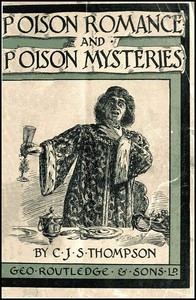
For Poison Romance and Poison Mysteries — Context and Discussion, the stored edition analysis reports 46,982 words, 3 hr 25 min estimated reading time, and 5 detected text sections.
The text analysis averages about 23.6 words per sentence, while the detected sections provide another way to judge how the source is divided.
Project Gutenberg metadata also associates the work with “Poisoners,” connecting these edition facts with the source record’s subject description.
Explore this collection
These alternatives are selected using recorded categories and estimated reading time.
About 241 minutes
Society Culture
55,369 recorded words. 36 minutes difference from this book's estimate.
View Gutenberg source #52634About 155 minutes
Society Culture
35,563 recorded words. 50 minutes difference from this book's estimate.
View Gutenberg source #69574About 132 minutes
Society Culture
30,163 recorded words. 73 minutes difference from this book's estimate.
View Gutenberg source #69557Search stored excerpts and compare books → Choose by your preferences →
Choices use stored catalog measurements. Estimates vary with reading speed. A shared category is a catalog label, not a claim that two books have the same argument or literary quality.
Search reads excerpt text stored with this catalog and links to its associated Gutenberg record. The connection is stored in the site database; this tool does not recheck that every excerpt is word-for-word identical to that external record. Excerpt search does not cover every chapter and does not verify historical publication dates.
Catalog snapshot checked: 2026-09-26. Coverage: 93 public books, 93 available source excerpts.
Calculated from edition completeness, EPUB availability, text structure and catalogue metadata. Not a user rating.
Total of 100 points, scaled to a 2.5-5.0 range. Editions with an empty description or a missing EPUB file are not scored.
Public-domain source text
The source text is kept in the dedicated reader, separate from this catalogue record and its commentary.
Thompson opens with a striking epigraph from Eno's 'Fruit Salt' advertisement—'Conquest over human pain'—before plunging into a world where poison is both a medical tool and a weapon. The book's structure alternates between sensational criminal cases, such as the 1865 trial of Dr. Pritchard for poisoning his wife and mother-in-law with antimony, and more literary or historical accounts of poison rings, gloves, and love philters. The excerpts show a fascination with the gap between public perception and forensic reality: in the Pritchard case, the initial diagnosis of apoplexy and gastric fever masked deliberate antimony poisoning, revealed only through post-mortem analysis and exhumation.
The trial of Dr. Edward Pritchard, detailed in the excerpts, illustrates how social position initially shielded a poisoner. Thompson notes that Pritchard's 'position occupied by the accused man in society in Glasgow' and his six-year medical practice 'awakened an unusual degree of attention.' The deaths of Mrs. Taylor (aged seventy, attributed to apoplexy) and her daughter Mrs. Pritchard (gastric fever) were accepted until police, alerted by 'certain hints,' ordered exhumations. The post-mortem by Professors Maclagan, Gamgee, and Littlejohn found 'minute particles of antimony in the liver.' Thompson emphasizes the procedural shift from natural causes to criminal inquiry, highlighting the role of forensic chemistry in overturning initial assumptions.
Thompson devotes space to 'poisoned gloves and rings of old romance,' as noted in a contemporary review. These objects, often associated with Renaissance courts, blur the line between legend and documented history. The author treats them as both literary motifs and real hazards, citing cases where victims absorbed toxins through skin contact. The excerpts do not provide full details, but the pattern suggests Thompson is interested in how poison operates as a narrative device—a 'subtle and mystic' element, per the Daily Chronicle review—while also grounding it in pharmacological fact. This dual approach, mixing anecdote with analysis, recurs throughout the book.
Thompson's chapter on 'toxicology in fiction' is described by Literature magazine as 'sprightly.' The excerpts do not reveal which novels he discusses, but the book's title—Poison Romance and Poison Mysteries—signals a deliberate pairing of romanticized and forensic accounts. The Illustrated London News review notes that 'the story portions will attract most attention,' suggesting Thompson uses narrative to make toxicology accessible. He likely contrasts fictional portrayals (e.g., the 'poisoned gloves and rings of old romance') with real cases, showing how popular imagination both distorts and mirrors actual criminal methods. The book seems to argue that poison's cultural fascination stems from its invisibility and intimacy.
Thompson's work is best approached as a collection of case studies and curiosities rather than a systematic treatise. Readers interested in the Pritchard trial will find a detailed procedural account, while those drawn to the romance of historical poisons should expect a mix of verified fact and period speculation. The book rewards selective reading: skip the lengthy advertisements and focus on the narrative portions, where Thompson's background as a toxicologist lends authority to his descriptions of symptoms, autopsies, and chemical analyses.
Reading about poison’s slow, patient work in those old cases made me think of how houses hold their histories, too—walls absorbing whispers and weather. There’s a quiet weight in both, a lingering trace of lives lived intensely. That feeling came back while leafing through Hawkins-Davison Houses, Frederica, St. Simons Island, Georgia — Inside the Classic, where every room seems to keep a secret. I closed it feeling oddly tender toward time.
Use these questions to collect your thoughts before moving on.