About 494 minutes
The Coal Measures Amphibia of North America — A Reader’s Guide
Society Culture
113,485 recorded words. 276 minutes difference from this book's estimate.
View Gutenberg source #59662
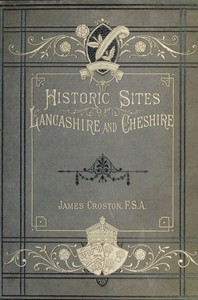
Historic Sites of Lancashire and Cheshire A Wayfarer's Notes in the Palatine Counties, Historical, Legendary, Genealogical, and Descriptive. — Story, Setting & Ideas can be approached with a clearer sense of reading commitment from its source measurements: 177,080 words, 12 hr 50 min estimated reading time, and 26 detected text sections.
The text analysis averages about 32.5 words per sentence, while the detected sections provide another way to judge how the source is divided.
Project Gutenberg metadata also associates the work with “Lancashire (England),” connecting these edition facts with the source record’s subject description.
Explore this collection
These alternatives are selected using recorded categories and estimated reading time.
About 494 minutes
Society Culture
113,485 recorded words. 276 minutes difference from this book's estimate.
View Gutenberg source #59662About 492 minutes
Society Culture
113,070 recorded words. 278 minutes difference from this book's estimate.
View Gutenberg source #57877About 1,076 minutes
Society Culture
247,439 recorded words. 306 minutes difference from this book's estimate.
View Gutenberg source #49912Search stored excerpts and compare books → Choose by your preferences →
Choices use stored catalog measurements. Estimates vary with reading speed. A shared category is a catalog label, not a claim that two books have the same argument or literary quality.
Search reads excerpt text stored with this catalog and links to its associated Gutenberg record. The connection is stored in the site database; this tool does not recheck that every excerpt is word-for-word identical to that external record. Excerpt search does not cover every chapter and does not verify historical publication dates.
Catalog snapshot checked: 2026-09-26. Coverage: 93 public books, 93 available source excerpts.
Calculated from edition completeness, EPUB availability, text structure and catalogue metadata. Not a user rating.
Total of 100 points, scaled to a 2.5-5.0 range. Editions with an empty description or a missing EPUB file are not scored.
Public-domain source text
The source text is kept in the dedicated reader, separate from this catalogue record and its commentary.
James Croston's Historic Sites of Lancashire and Cheshire (1883) opens with a preface that distinguishes his method from conventional history: he aims to give particular localities 'an individuality and freshness' by weaving together 'well-attested facts, topographical description, personal narrative and local legend.' The book's subtitle—'A Wayfarer's Notes'—signals a peripatetic, anecdotal approach, and Croston, a Fellow of the Society of Antiquaries, grounds his observations in archival research while leaving room for the 'warm colouring of romance.'
In the excerpt on Cartmel, for instance, he moves from a charter of King Ecgfrith (c. 680) granting 'the whole of the lands called Cartmel, with all the Britons in it' to a medieval foundation legend involving a mysterious voice directing monks to 'a valley between two rivers.' This layering of documentary evidence and oral tradition is characteristic of Croston's method throughout the volume.
Croston's prose is deliberately antiquarian, favoring Latinate constructions and formal period syntax. He describes the Cartmel monks 'plodding their way wearily through the tangled forests' and writes of 'the cold outlines of historic fact' being filled in by 'the warm colouring of romance.' His vocabulary includes terms like 'entrenched camp,' 'fraternity of canons regular,' and 'aboriginal Britons,' reflecting his membership in historical and archaeological societies. Yet he occasionally shifts to a more direct, almost conversational tone—as when he notes that 'the poor homeless fathers' obeyed a 'supernatural command'—which humanizes the narrative without sacrificing precision.
Croston rarely reproduces direct speech, but he frequently paraphrases historical documents and legends in a way that mimics oral testimony. The Cartmel foundation story is relayed as 'it is said' that the canons 'somehow or other found their way into this remote corner of Lancashire,' and a 'mysterious voice' directed them to a new site. This indirect discourse preserves the flavor of local tradition while allowing Croston to maintain scholarly distance. When he quotes a charter—'Willelmus Clericus de Kertmel'—he does so to anchor legend in verifiable record, creating a dialogue between written evidence and folk memory.
Croston's descriptions are notably specific about topography and architecture. He notes that the Roman camp at Cartmel was 'in the fields on the bank of the little river Ea, now called the Beck, a little to the north-west of the church,' and that the fields are 'known as the Castle Meadows.' He identifies a hill 'commanding an agreeable prospect' and a valley 'between two rivers, where the one runs north and the other south.' Such details ground the narrative in observable geography, allowing readers to trace the sites themselves. His eye for physical setting—'a green nook hidden away among the bleak mountain solitudes'—evokes both the isolation and the allure of these historic locations.
The book's structure mirrors its subtitle: each chapter treats a specific site, moving chronologically through its history but pausing for legend, genealogy, and architectural description. Croston frequently signals gaps in knowledge—'a chasm of something like five centuries occurs in the history'—and acknowledges uncertainty ('it is not unreasonable to assume'). This honest handling of incomplete evidence distinguishes his work from more sweeping histories. The wayfarer conceit allows him to digress without losing coherence, as when he follows the Cartmel monks' wanderings step by step, building suspense before their eventual discovery of the vale.
Readers approaching Historic Sites of Lancashire and Cheshire will find it most rewarding when read as a companion to a map or a visit to the locations themselves. Croston's method—alternating between documentary evidence and local legend—invites the reader to weigh the reliability of each source. The book is not a continuous narrative but a series of discrete explorations; dipping into individual chapters yields the richest experience. Pay attention to the footnotes and the author's asides, where his personality and scholarly caution emerge most clearly.
There’s something about Croston’s way of wandering—how he lets a ruin tell its own slow story—that reminds me of another quiet companionship. His stones hold centuries; the amphibian bones in The Coal Measures Amphibia of North America — A Reader’s Guide hold eons. Both left me feeling strangely grateful, as if the past had simply touched my sleeve and moved on.
Create a short personal record of your experience with this book.