About 241 minutes
Women's Work — Key Ideas to Explore
Society Culture
55,369 recorded words. 39 minutes difference from this book's estimate.
View Gutenberg source #52634
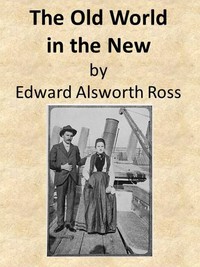
The catalog record for The Old World in the New The Significance of Past and Present Immigration to the American People — Reading Notes provides practical reading context through 64,291 words, 4 hr 40 min estimated reading time, and 13 detected text sections.
The text analysis averages about 19.9 words per sentence, while the detected sections provide another way to judge how the source is divided.
Project Gutenberg metadata also associates the work with “Immigrants -- United States,” connecting these edition facts with the source record’s subject description.
Explore this collection
These alternatives are selected using recorded categories and estimated reading time.
About 241 minutes
Society Culture
55,369 recorded words. 39 minutes difference from this book's estimate.
View Gutenberg source #52634About 327 minutes
Society Culture
75,045 recorded words. 47 minutes difference from this book's estimate.
View Gutenberg source #38205About 328 minutes
Society Culture
75,320 recorded words. 48 minutes difference from this book's estimate.
View Gutenberg source #40914Search stored excerpts and compare books → Choose by your preferences →
Choices use stored catalog measurements. Estimates vary with reading speed. A shared category is a catalog label, not a claim that two books have the same argument or literary quality.
Search reads excerpt text stored with this catalog and links to its associated Gutenberg record. The connection is stored in the site database; this tool does not recheck that every excerpt is word-for-word identical to that external record. Excerpt search does not cover every chapter and does not verify historical publication dates.
Catalog snapshot checked: 2026-09-26. Coverage: 93 public books, 93 available source excerpts.
Calculated from edition completeness, EPUB availability, text structure and catalogue metadata. Not a user rating.
Total of 100 points, scaled to a 2.5-5.0 range. Editions with an empty description or a missing EPUB file are not scored.
Public-domain source text
The source text is kept in the dedicated reader, separate from this catalogue record and its commentary.
Edward Alsworth Ross opens The Old World in the New with a pointed dialogue between himself and an unnamed social worker who sees immigration as a force spreading democratic ideals worldwide. Ross counters this vision by insisting that the nation's future—its standards of living, institutions, and ideals—must not be sacrificed for the benefit of 'pent-up millions in the backward lands.' This preface establishes the book's central tension: the pull between humanitarian sympathy for immigrants and a protective concern for American society. Ross writes as a sociologist at the University of Wisconsin, and his language throughout is analytical, often blunt, and grounded in contemporary racial theories.
Ross's prose is direct and argumentative, frequently using contrast to sharpen his points. In the preface, he sets up a social worker's idealistic view—'a wind that blows democratic ideas throughout the world'—only to undercut it with his own priorities: 'I am not of those who consider humanity and forget the nation.' This rhetorical strategy recurs throughout the excerpts. He characterizes groups with sweeping assertions: the Jew 'loves without romance and fights without hatred,' while the Yankee 'can meet the Jew on his own ground' due to shared rationalism. Such statements reveal Ross's reliance on broad ethnic typologies, a common approach in early twentieth-century sociology. The voice is confident, even combative, as when he dismisses charges of bigotry by claiming that what is 'disliked in the Jews is not their religion but certain ways and manners.'
The narrative pace varies markedly between sections. The preface moves slowly, building an abstract argument about national versus humanitarian obligations. In contrast, later passages accelerate with concrete examples: General Grant's wartime order to 'refuse all permits to Jews to come South,' the 'sky-rocket careers' from peddler to banker, and the claim that 'charity agents say... Hebrew cases... cost them more.' These anecdotes inject immediacy and a quasi-journalistic tone. Ross also uses reported speech—'the genial editor of Vorwaerts, Mr. Abram Cahan, tells me'—to ground his claims in contemporary testimony. The effect is a work that oscillates between sociological generalization and vivid, sometimes jarring, particularity.
Ross repeatedly frames immigrant traits in terms of tenacity, adaptability, and economic behavior. The Jews are described with a cluster of attributes: 'great tenacity of purpose,' 'stiff-necked,' 'flexible and rational,' and 'wonderful adaptability.' He notes their reliability as insurance policy holders and their stubbornness as strikers. The Irish are mentioned only briefly, in contrast to Jewish 'personal loyalty or hostility.' Yankees receive a 'cousinly feeling' due to shared Hebraic roots. These characterizations are not neutral; they carry evaluative weight, as when Ross notes that 'the line is drawn against the Jews in hotels, resorts, clubs, and private schools' and that this 'cruel prejudice... appears to spring out of contemporary experience.' The excerpts do not reveal how Ross treats other groups, but the pattern of linking economic roles to ethnic stereotypes is clear.
Readers should approach The Old World in the New as a primary document of early American sociology, noting how Ross's language and pace serve his argumentative goals. The book's value lies less in its conclusions than in its revelation of the assumptions and rhetorical strategies that shaped public discourse on immigration a century ago. Pay attention to how Ross balances statistical or observational claims with moral framing, and consider what voices—immigrants themselves, for instance—are absent from his account.
There’s something achingly familiar in Ross’s worry about who belongs, that old hinge between compassion and fear. It made me think of a quieter, starker plea from across the sea, where poverty wasn’t a matter of national character but of raw survival. I kept returning to that other book in my mind, The Bitter Cry of Outcast London An Inquiry into the Condition of the Abject Poor — Background and Themes, and wondered if every generation simply relearns the same ache.
Use these questions to collect your thoughts before moving on.