About 57 minutes
Montezuma Castle National Monument, Arizona (1977) — Themes and Context
Society Culture
12,937 recorded words. 6 minutes difference from this book's estimate.
View Gutenberg source #49607
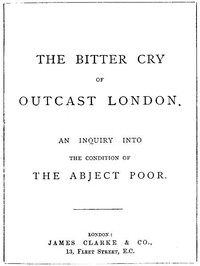
For The Bitter Cry of Outcast London An Inquiry into the Condition of the Abject Poor — Background and Themes, the stored edition analysis reports 11,624 words, 51 min estimated reading time, and 2 detected text sections.
The text analysis averages about 23.8 words per sentence, while the detected sections provide another way to judge how the source is divided.
Project Gutenberg metadata also associates the work with “Poor -- England -- London,” connecting these edition facts with the source record’s subject description.
Explore this collection
These alternatives are selected using recorded categories and estimated reading time.
About 57 minutes
Society Culture
12,937 recorded words. 6 minutes difference from this book's estimate.
View Gutenberg source #49607About 58 minutes
Society Culture
13,267 recorded words. 7 minutes difference from this book's estimate.
View Gutenberg source #64684About 60 minutes
Society Culture
13,679 recorded words. 9 minutes difference from this book's estimate.
View Gutenberg source #53631Search stored excerpts and compare books → Choose by your preferences →
Choices use stored catalog measurements. Estimates vary with reading speed. A shared category is a catalog label, not a claim that two books have the same argument or literary quality.
Search reads excerpt text stored with this catalog and links to its associated Gutenberg record. The connection is stored in the site database; this tool does not recheck that every excerpt is word-for-word identical to that external record. Excerpt search does not cover every chapter and does not verify historical publication dates.
Catalog snapshot checked: 2026-09-26. Coverage: 93 public books, 93 available source excerpts.
Calculated from edition completeness, EPUB availability, text structure and catalogue metadata. Not a user rating.
Total of 100 points, scaled to a 2.5-5.0 range. Editions with an empty description or a missing EPUB file are not scored.
Public-domain source text
The source text is kept in the dedicated reader, separate from this catalogue record and its commentary.
The Bitter Cry of Outcast London opens with a striking admission: the Christian Church has only 'touched the merest edge of the great dark region of poverty, misery, squalor and immorality.' Andrew Mearns and William C. Preston frame their inquiry as a corrective to complacent religious philanthropy, arguing that district visitation and scattered charities have failed to reach the 'vast mass of moral corruption' seething beneath the city's surface. The authors adopt a tone of urgent indictment, contrasting the church's self-solacing religion with the widening gulf between the lowest classes and 'all decency and civilization.'
The authors repeatedly map moral states onto physical spaces. London's poor are described as inhabiting an 'awful slough,' a 'great dark region,' and a 'living tomb.' This language transforms tenement rooms into metaphors for spiritual abandonment. The phrase 'concealed by the thinnest crust of civilization' suggests that respectability is a fragile veneer over a rotting core. Such diction does more than describe; it accuses the comfortable classes of willful ignorance. The report insists that the 'gulf' separating the poor from churches is not merely economic but moral, and that it is widening daily. By choosing words like 'seething' and 'corruption,' Mearns and Preston align their investigation with the rhetoric of contagion, implying that inaction threatens the entire social body.
The text shifts between two voices: the detached investigator and the impassioned advocate. The opening paragraphs adopt a measured, almost bureaucratic tone—acknowledging the London City Mission, listing institutional failures. But this gives way to a more visceral register when describing individual cases. A dying mother 'propped up in a chair' washing clothes despite dropsy is presented as a 'touching sight,' yet the authors immediately pivot to say they 'might unveil many more painful ones.' This alternation serves a rhetorical purpose: the cold facts establish credibility, while the vignettes generate moral outrage. The authors anticipate incredulity, writing 'We are quite prepared for incredulity,' and counter it by insisting their sketches are 'faintest outline' of a darker truth. The dialogue is thus a calculated performance of evidence and emotion.
The report's structure mirrors its argument: relentless accumulation of detail. Paragraphs are dense with lists—'poverty, misery, squalor and immorality'; 'Missions, Reformatories, Refuges, Temperance Societies.' This piling-up creates a sense of overwhelming scale. The authors rarely pause for analysis; instead, they move from general indictment to specific case, then back to systemic critique. The section 'WHAT IT IS PROPOSED TO DO' introduces a new structural element: a direct appeal for state intervention. Here the prose becomes more declarative, calling for the State to 'make short work of this iniquitous traffic.' The shift from description to prescription is abrupt, suggesting that the evidence itself demands action. The structure thus enacts the authors' belief that documentation must precede and compel reform.
Certain images recur with variations: overcrowded rooms, insufficient clothing, the struggle to maintain cleanliness. A mother dying of dropsy still attempts to wash her children's clothes; another woman, though ill, has 'the cleanest and tidiest' children in the Board School. These details are not incidental—they serve as proof of moral worth in the face of degradation. The authors emphasize that the poor show 'brave patience' and 'tender sympathy' toward each other, countering any assumption that poverty breeds only vice. Yet the same details also underscore the futility of individual effort against systemic neglect. The recurring motif of cleanliness amid squalor becomes a silent indictment of a society that forces such heroism to go unnoticed and unsupported.
Readers should attend to how Mearns and Preston balance statistical generalization with specific, named witnesses—a technique that anticipates later social survey methods. The report's power lies not in originality of observation but in its strategic arrangement of evidence to shame the church and state into action. The excerpts leave the full scope of the authors' proposals unclear, but the rhetorical pattern is unmistakable: each paragraph builds a case that the reader cannot dismiss without complicity.
That damp afternoon, the weight of The Bitter Cry of Outcast London pressed against my lap, its tales of cramped misery somehow echoing the quiet rain outside. Yet its steady insistence on observation, on asking what surrounds us, drifted oddly into thoughts of open Western skies and time compressed in stone. Later, The Dinosaur Quarry. Dinosaur National Monument, Colorado-Utah — Key Ideas to Explore sat on my table, a different kind of volume, about layers and lost worlds.
Capture what you thought, learned, and would like to remember.