About 205 minutes
Poison Romance and Poison Mysteries — Context and Discussion
Society Culture
46,982 recorded words. 36 minutes difference from this book's estimate.
View Gutenberg source #43840
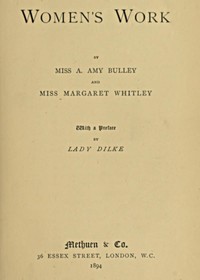
Women's Work — Key Ideas to Explore can be approached with a clearer sense of reading commitment from its source measurements: 55,369 words, 4 hr 1 min estimated reading time, and 8 detected text sections.
The text analysis averages about 23.4 words per sentence, while the detected sections provide another way to judge how the source is divided.
Project Gutenberg metadata also associates the work with “Women -- Employment,” connecting these edition facts with the source record’s subject description.
Explore this collection
These alternatives are selected using recorded categories and estimated reading time.
About 205 minutes
Society Culture
46,982 recorded words. 36 minutes difference from this book's estimate.
View Gutenberg source #43840About 280 minutes
Society Culture
64,291 recorded words. 39 minutes difference from this book's estimate.
View Gutenberg source #47954About 327 minutes
Society Culture
75,045 recorded words. 86 minutes difference from this book's estimate.
View Gutenberg source #38205Search stored excerpts and compare books → Choose by your preferences →
Choices use stored catalog measurements. Estimates vary with reading speed. A shared category is a catalog label, not a claim that two books have the same argument or literary quality.
Search reads excerpt text stored with this catalog and links to its associated Gutenberg record. The connection is stored in the site database; this tool does not recheck that every excerpt is word-for-word identical to that external record. Excerpt search does not cover every chapter and does not verify historical publication dates.
Catalog snapshot checked: 2026-09-26. Coverage: 93 public books, 93 available source excerpts.
Calculated from edition completeness, EPUB availability, text structure and catalogue metadata. Not a user rating.
Total of 100 points, scaled to a 2.5-5.0 range. Editions with an empty description or a missing EPUB file are not scored.
Public-domain source text
The source text is kept in the dedicated reader, separate from this catalogue record and its commentary.
The volume opens with a preface by Lady Dilke that immediately establishes the authors' practical orientation: they 'have no desire to discuss, theoretically, the duties, rights, and responsibilities of women.' Instead, the book focuses on the industrial situation of women, deliberately setting aside political or social considerations. This framing shapes the entire work, which moves from detailed accounts of specific trades—such as the agitation against women working at pit brows in Lancashire—to broader analyses of unionization and wage trends. The authors repeatedly return to the tension between public outcry against certain employments and the need for practical improvements, arguing that 'the true cure lies in the formation of unions among the women.'
The book is organized into eight sections that trace a logical progression from general principles to specific industries and then to remedies. After the preface and introductory matter, the authors examine the historical context of women's work, then move through manufacturing trades, the textile industry, domestic service, and the professions. Each section builds on the previous one, creating a cumulative picture of the industrial landscape. The movement between scenes is not merely descriptive but analytical: the authors compare conditions across trades, noting, for example, that 'trades carried on wholly in factories have hitherto proved the most amenable to combination,' while home work remains resistant to organization. This structural choice allows readers to see both the diversity of women's employment and the common challenges they face.
Throughout the excerpts, a recurring contrast emerges between isolation and collective action. The authors describe home workers as 'isolated,' their wages kept down by the lack of companionship and legal protection. In Cradley Heath, near Birmingham, the home 'is, upon the testimony of Miss Orme, Senior Assistant Commissioner, almost always “desolate.”' Against this image of fragmentation, the book sets the growing power of trade unions. The authors note that 'the older members of badly-paid trades know this well, and it is among them that the keenest advocates of combination are found.' The language of solidarity—'solid front,' 'support of companionship'—recurs as a counterweight to the isolation of individual workers. This binary structure gives the argument a moral and emotional force, even as the authors maintain a factual tone.
The authors ground their claims in specific evidence, citing reports by Miss Collet, Miss Abraham, and Miss Orme, all Senior Assistant Commissioners. This reliance on official investigations gives the book an empirical weight. For instance, Miss Collet's report on Liverpool mentions a union of tailoresses that 'succeeded in obtaining a shortening of eleven hours in the working week.' In the lace trade, Miss Abraham notes that 'the formation of a trade union among the workers has had the effect of checking the system' of heavy fines. The authors do not simply assert the benefits of unionization; they present concrete examples. This method reflects the book's place in the 'Social Questions of To-Day' series, which aimed to treat each subject 'in a thoroughly sympathetic but impartial manner, with special reference to the historic aspect.'
A persistent theme is the misdirection of public concern. The authors criticize campaigns that focus on morality rather than working conditions, as in the Lancashire pit-brow agitation, where 'the charge of immorality was most unjustly raised against them, and even their peculiar but necessary costume was made the ground of serious indictments.' They argue that such energy, 'if more wisely directed, might have secured for the women improved arrangements for their comfort.' The book advocates for legislative intervention, particularly regarding domestic workshops, where 'it seems probable that legislation will in time bring these irregular divisions of the labour army into line with the main body.' This forward-looking stance, combined with a clear-eyed assessment of current obstacles, gives the work a reformist edge without descending into polemic.
Readers approaching this book will find a methodical survey of women's industrial work at the end of the nineteenth century, grounded in official reports and case studies. The authors maintain a practical focus, avoiding theoretical debates about women's rights. The structure moves from general principles to specific trades and then to solutions, with unionization emerging as the central remedy. The book is best read as a document of its time, revealing both the conditions women faced and the arguments that shaped early reform efforts.
That rainy afternoon, reading about seamstresses striking in 1894, I kept picturing their worn hands against rough cloth, their voices somehow muffled by time. The book stayed closed on my lap while the window blurred, and almost without intention I reached for Excavations at the LoDaisKa Site in the Denver, Colorado area — Background and Themes, wondering what else gets buried under what we think we know.
A brief reflection can help important ideas stay with you longer.