About 39 minutes
American Antiquities. Auction Catalogue, January 8, 1898 — Reading Companion
Society Culture
8,813 recorded words. 1 minutes difference from this book's estimate.
View Gutenberg source #36598
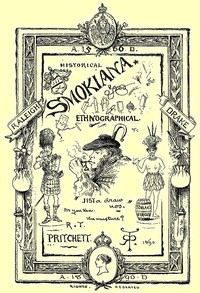
Before opening Smokiana: Historical; Ethnographical — Context and Discussion, the edition data offers a quick orientation: 8,697 words, 38 min estimated reading time, and 53 detected text sections.
The text analysis averages about 18.1 words per sentence, while the detected sections provide another way to judge how the source is divided.
Project Gutenberg metadata also associates the work with “Smoking,” connecting these edition facts with the source record’s subject description.
Explore this collection
These alternatives are selected using recorded categories and estimated reading time.
About 39 minutes
Society Culture
8,813 recorded words. 1 minutes difference from this book's estimate.
View Gutenberg source #36598About 51 minutes
Society Culture
11,624 recorded words. 13 minutes difference from this book's estimate.
View Gutenberg source #55316About 57 minutes
Society Culture
12,937 recorded words. 19 minutes difference from this book's estimate.
View Gutenberg source #49607Search stored excerpts and compare books → Choose by your preferences →
Choices use stored catalog measurements. Estimates vary with reading speed. A shared category is a catalog label, not a claim that two books have the same argument or literary quality.
Search reads excerpt text stored with this catalog and links to its associated Gutenberg record. The connection is stored in the site database; this tool does not recheck that every excerpt is word-for-word identical to that external record. Excerpt search does not cover every chapter and does not verify historical publication dates.
Catalog snapshot checked: 2026-09-26. Coverage: 93 public books, 93 available source excerpts.
Calculated from edition completeness, EPUB availability, text structure and catalogue metadata. Not a user rating.
Total of 100 points, scaled to a 2.5-5.0 range. Editions with an empty description or a missing EPUB file are not scored.
Public-domain source text
The source text is kept in the dedicated reader, separate from this catalogue record and its commentary.
R. T. Pritchett’s Smokiana: Historical; Ethnographical (1890) is structured as a visual catalog of smoking pipes from around the world, moving region by region from Europe through Africa, Asia, the Pacific, and the Americas. The book’s organizing principle is the westward-to-eastward spread of tobacco use, which Pritchett frames as the triumph of the “Goddess Nicotina.” Each entry pairs a hand-drawn illustration with a brief ethnographic note, emphasizing the pipe as an object of both historical and ethnographical interest.
The work’s structure is driven by the sequence of plates, each depicting a specific pipe or smoking implement. Pritchett’s commentary is terse and observational, often noting materials (bamboo, briar, clay), ornamentation, and how the pipe is used or carried. The text is handwritten in the original, with inconsistent spelling and capitalization, a feature preserved in this digital edition.
Pritchett repeatedly treats the pipe as a cultural artifact that records the artistic and technological state of its society. In the New Zealand entry, he writes that “Pipes seem to be a general register of the art of the Country in which they are made,” noting that the carved work on a briar pipe “assumes a new type” during a “transition period” when traditional ornamentation is “fast passing away.” The pipe’s design—a spike to stick into the ground, like a linstock—reflects both practical and symbolic functions. Similarly, the Dyak pipe from Borneo is valued because it was “acquired from the original owner when using it,” adding ethnographic authenticity. Pritchett’s focus on use-wear and provenance underscores his belief that a well-used object carries more historical weight than a pristine specimen.
The book’s ethnographic survey highlights the diversity of materials and construction techniques. Bamboo appears frequently: in Borneo, the stem is “rather large according to our idea in proportion to the Bowl,” and the Dyak regulates the draft by inserting dry grass. In New Guinea, bamboo is “the material now in vogue,” with the mouthpiece formed by a hole at the joint, and the tobacco tube is “always at right angles to the thick stem.” Metal pipes are noted in Sumatra, where “large brass pipes from Batak-landen” are described, and a pin-cushion arrangement on the wooden bowl for the pricker is “very original.” Stone pipes appear in the North American section, while clay pipes dominate the European plates. Pritchett’s attention to these details reveals a systematic interest in how local resources and craftsmanship shape pipe design.
Pritchett is candid about gaps in his collection. In the Australia entry, he notes that Aboriginal people “have not been found worshippers of the Goddess ‘NICOTINA,’” though a wild tobacco was discovered near Port Jackson. He admits, “in vain have we sought a native Pipe,” and the specimen shown is attributed to a “Heathen Chinee or more likely MALAY.” This honesty about missing data contrasts with the confident tone of other entries. Similarly, the Sumatra section remarks that the Acheen section is “a little thin,” while the Java museum’s collection is praised as “one of the most instructive.” These admissions remind the reader that Smokiana is a personal collection, not a comprehensive survey, and that its authority rests on the author’s direct observation and acquisition.
The book’s structure moves the reader rapidly across continents, often with abrupt transitions. The Japan entry describes “this most delightful country” and notes that the small bowl size leads many to mistakenly think opium is used; the tobacco is “very light in Colour & very fine cut.” Pipe cases suspended from the girdle by carved netsuke are praised as “lovely.” From Japan, the reader jumps to Borneo, then Sumatra, then Australia, each entry a self-contained vignette. The Arctic pipes appear near the end, with a plate titled “Arctic Pipes. IGNITION.” This geographical sweep, from the tropics to the poles, reinforces Pritchett’s claim that tobacco use has “girdled our little orb.” The lack of connective narrative between entries places the burden on the reader to compare and contrast the objects, much like browsing a museum display.
Smokiana rewards readers who approach it as a cabinet of curiosities rather than a systematic treatise. The handwritten original and the transcriber’s note about inconsistent spelling and capitalization add a layer of historical texture. Pritchett’s voice—at once scholarly and personal, with asides about his own collecting practices—makes the book a document of late-Victorian ethnographic enthusiasm. Readers interested in material culture, the history of smoking, or the aesthetics of the pipe will find much to examine in these pages.
Flipping through Smokiana, I recalled my grandfather’s clay pipe, its bowl worn smooth by decades of thumbs. The survey’s careful drawings felt like a whisper of that same devotion—objects holding hands across centuries. Years ago, A definition of social work: A thesis in sociology — Key Ideas to Explore stirred the same quiet ache: how we document lives to make sense of our own quiet rituals, one small thing at a time.
A brief reflection can help important ideas stay with you longer.