About 60 minutes
Canyon de Chelly: The Story of Its Ruins and People — Reading Companion
Society Culture
13,679 recorded words. 2 minutes difference from this book's estimate.
View Gutenberg source #53631
The Caddo Indians of Louisiana — Reading Notes can be approached with a clearer sense of reading commitment from its source measurements: 14,077 words, 1 hr 2 min estimated reading time, and 18 detected text sections.
The text analysis averages about 18.1 words per sentence, while the detected sections provide another way to judge how the source is divided.
Project Gutenberg metadata also associates the work with “Louisiana -- Antiquities,” connecting these edition facts with the source record’s subject description.
Explore this collection
These alternatives are selected using recorded categories and estimated reading time.
About 60 minutes
Society Culture
13,679 recorded words. 2 minutes difference from this book's estimate.
View Gutenberg source #53631About 58 minutes
Society Culture
13,267 recorded words. 4 minutes difference from this book's estimate.
View Gutenberg source #64684About 57 minutes
Society Culture
12,937 recorded words. 5 minutes difference from this book's estimate.
View Gutenberg source #49607Search stored excerpts and compare books → Choose by your preferences →
Choices use stored catalog measurements. Estimates vary with reading speed. A shared category is a catalog label, not a claim that two books have the same argument or literary quality.
Search reads excerpt text stored with this catalog and links to its associated Gutenberg record. The connection is stored in the site database; this tool does not recheck that every excerpt is word-for-word identical to that external record. Excerpt search does not cover every chapter and does not verify historical publication dates.
Catalog snapshot checked: 2026-09-26. Coverage: 93 public books, 93 available source excerpts.
Calculated from edition completeness, EPUB availability, text structure and catalogue metadata. Not a user rating.
Total of 100 points, scaled to a 2.5-5.0 range. Editions with an empty description or a missing EPUB file are not scored.
Public-domain source text
The source text is kept in the dedicated reader, separate from this catalogue record and its commentary.
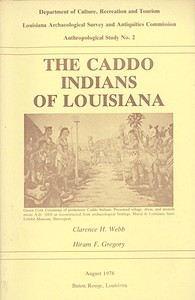
The Caddo Indians of Louisiana opens with a striking mural reconstruction of a Green Corn Ceremony around A.D. 1000, immediately grounding the reader in the archaeological perspective that defines this study. Co-authored by a physician-archaeologist and an anthropologist, the work deliberately bridges scientific excavation and historical documentation. The authors emphasize that the term "Caddo" itself is a colonial shorthand, obscuring the distinct political identities of groups like the Kadohadacho, Hasinai, and Natchitoches. This tension between imposed labels and lived realities runs throughout the text.
The Louisiana Caddoans found themselves caught between Spanish and American spheres. The excerpts highlight how East Texas tribes remained under Spanish domination while their Louisiana neighbors fell under American control after the Louisiana Purchase. This geopolitical split disrupted long-standing trade and kinship networks. The authors note that American agents began treating the diverse Caddoan groups as a single entity by 1834, using the term "Caddo" as a cover for the Kadohadacho confederacy. This administrative simplification had real consequences: it enabled the United States to negotiate a single land cession treaty in 1835, effectively erasing the separate political existences that Spanish and French officials had previously recognized.
On July 1, 1835, approximately 489 Caddo gathered near Shreveport to cede about one million acres. The treaty was signed by chiefs Tarsher (Wolf) and Tsauninot, with interpreter Larkin Edwards—so trusted that the Caddo reserved him a sizable piece of land. The mixed Caddo-French Grappe family also received a reserved block, reflecting François Grappe's service as an interpreter who lost his position for protecting the Caddo from American traders. The payment of $80,000, partly in goods, was followed by annual installments. Yet the treaty did not bring stability: Tarsher led his people to Texas, only to face hostility from Texan authorities, while Chief Cissany's group lingered in Louisiana until credit was cut off and protection failed, eventually moving to Oklahoma.
The authors confront a central challenge: linking historic tribal locations to specific material remains. They cite multiple scholarly efforts (Wyckoff, Tanner, Williams, Gregory and Webb, Neuman) that attempt to connect archaeological sites with the Caddoan groups known from historical records. The text underscores that Spanish and French sources provide better information than American ones, because colonial officials recognized each group's political autonomy. This methodological caution pervades the study, reminding readers that the archaeological record does not neatly align with the tribal labels used in treaties. The Caddo presence in Louisiana, after more than a millennium, ended not with a single event but through a series of pressures—diplomatic, economic, and military—that gradually dissolved their hold on the land.
Readers should approach this study as a dual narrative: one thread traces the material culture and settlement patterns reconstructed from excavations, while the other follows the political maneuvering that led to removal. The authors deliberately avoid romanticizing either the pre-contact past or the treaty process. Instead, they present a careful, evidence-based account that respects the complexity of Caddoan identity. Pay attention to the footnoted sources—they reveal the ongoing scholarly debate about how to connect potsherds to people.
Rain drummed on the roof while I sat with the Caddo book, tracing how a people’s land quietly slipped away. That ache for rootedness lingered as I closed it. Later, my hand drifted to Indians of the Yosemite valley and vicinity Their history, customs and traditions — A Reader’s Guide, and I found the same gentle grief, told through different pines.
Create a short personal record of your experience with this book.